Many overhead line faults have nothing to do with the line itself. A crane or concrete pump touches a conductor on a construction site next to the right-of-way. A truck snags a guy wire at night. A boat mast hits a low river crossing. A raptor perched on a cross-arm releases a stream of droppings that bridges the insulator, and the line trips. Each of these is preventable, and most of the prevention comes down to two things: making the line visible and making it uninviting to birds.
This guide is for transmission and distribution engineers, maintenance contractors and distributors who supply them. It covers the main types of solar warning device, how to size them for your climate, how they are installed, where aviation rules apply, and how to write a specification.
The problems these devices solve
| Problem | Where it happens | Device |
|---|---|---|
| Machinery contact with live conductors | Construction sites, quarries, farms and roads under or beside lines | Voice warning lights and signs triggered by approach |
| Low conductors and spans not seen at night or in fog | River crossings, valleys, roads, construction access | Line-mounted solar warning lights |
| Vehicles striking guy wires | Distribution poles beside roads, yards and fields | Guy-wire warning lights |
| Bird nests, droppings and streamers causing flashover | Towers in open country, near water and on migration routes | Bird deterrents |
| People entering substations or work areas | Substation fences, temporary work zones | Sound-and-light warning units, warning posts |
Line-mounted solar warning lights
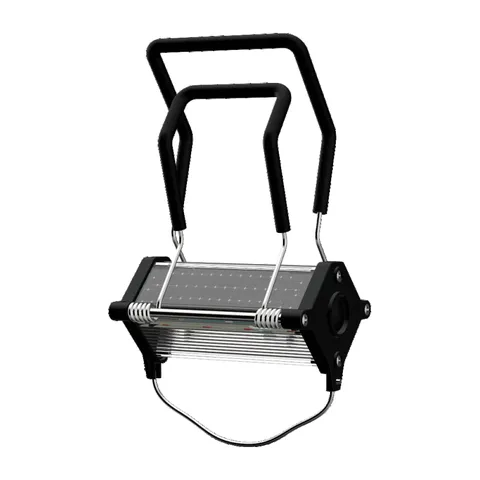
These clamp directly onto a conductor or earth wire and flash red at night, marking the span for crane operators, drivers and boat crews. The key requirements are low weight (so they do not load the conductor), immunity to the strong electric field around the line, and enough stored energy to keep flashing through a run of overcast days.
Our HZ4901 is designed for this: 155 g, a flexible 0.5 W solar panel, an interference-proof circuit rated for lines up to 220 kV, 300 hours of flashing from a full charge and a visible distance of about 1,000 m. It can be installed on a live line by drone with a dedicated bracket, which avoids an outage just to fit a warning light.
Voice warning lights and signs: stopping machinery strikes
A flashing light warns people who are looking. Machinery strikes usually happen when the operator is looking at the load, not the wires. Voice warning devices add a microwave motion sensor: when a person or vehicle comes within range, the device switches to a spoken warning and faster flashing.
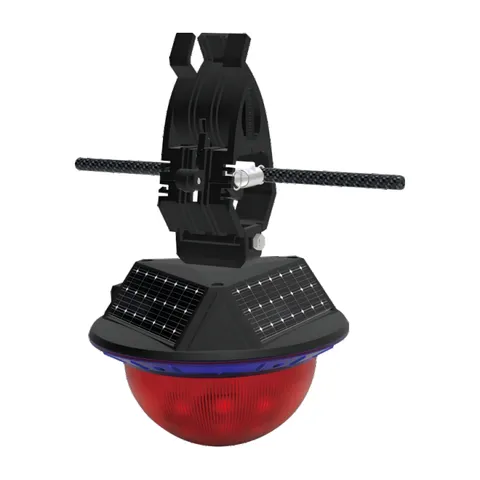
- HZ4903: line-mounted, 8 red and 12 blue LEDs visible at 1,000 m or more, 5–10 m microwave sensing, 70 dB voice at 5 m, ultrasonic bird repelling, and synchronised flashing with other units within 50 m.
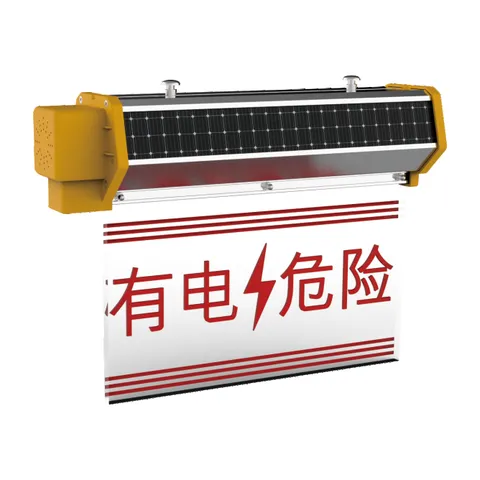
- HZ4915: a solar danger sign for tower legs and equipment frames. A red LED strip lights the sign at dusk, and a 5–15 m sensor triggers voice and flashing. The sign text can be printed in the language of the destination market.
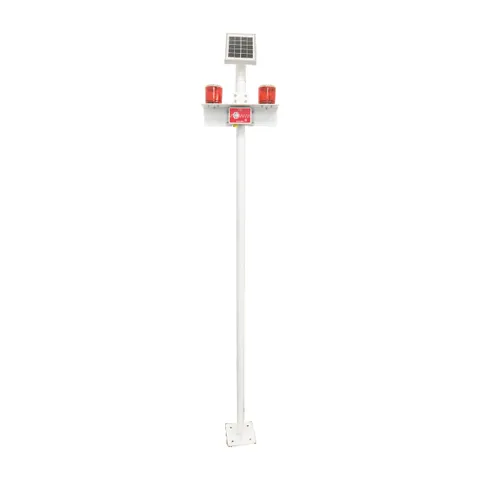
- HZ4863C: a ground-anchored solar post with a 160° sensor, for marking the edge of a safe working zone under a line.
Synchronised flashing is worth asking for. A row of lights flashing together reads as one line in the dark; lights flashing at random look like scattered points and are harder to interpret.
Guy-wire warning lights
Guy wires are thin, dark and almost invisible at night, and they often run down to ground level next to roads and yards. The HZ4905 comes in two forms: a sleeve version that slides over the wire, visible from 50 to 500 m, and a lighter wrap-around version visible from 30 to 300 m. Both switch on at dusk, flash in sync with neighbouring units within 50 m, and run through about seven rainy days on stored charge.
Bird deterrents for transmission towers
Birds cause line faults in several ways: nest material falling across insulators, droppings contaminating insulator surfaces, and "bird streamers", the long jets of excrement released by large birds as they take off from a cross-arm. A streamer is conductive enough to bridge the gap between a conductor and the grounded tower, causing a flashover without the bird touching anything. Bird-related problems are widespread: a survey cited by IEEE Spectrum found that 86% of utilities had bird-related trouble at substations.
The aim is to stop birds perching and nesting at the dangerous points without harming them. The HZ4878 uses a radar sensor (up to 10 m) to detect a bird approaching and then responds with a combination of laser, red and blue light, predator calls and ultrasound. Combining several kinds of stimulus makes it harder for birds to get used to the device. It runs on a 6 Wp panel, works for three rainy days on a full charge, and can be controlled by remote from 50 m.
Deterrents work best when combined with physical measures such as perch guards and insulator covers at the worst towers. Start with towers that have a fault history, then extend along the line.
Solar sizing: autonomy matters more than panel size
A solar warning device fails in the same way every time: a run of short, dull winter days drains the battery and it stops flashing. When comparing products, look at four figures together:
| Figure | What it tells you | Range in our products |
|---|---|---|
| Autonomy (days without sun) | How long it keeps working through bad weather | 3 rainy days (HZ4878) to 8 overcast days (HZ4901) |
| Runtime on a full charge | Total operating hours stored | 27 h for a sign with lit text, up to 300 h for a low-power line light |
| Solar panel output | How fast the battery recovers on a good day | 0.5 W to 2 × 3 Wp |
| Battery capacity and cycle life | Reserve and service life | About 1,000 cycles on the lithium models |
Adjust for your site. At high latitudes in winter, or in regions with long monsoon seasons, choose more autonomy than you think you need, and mount panels where trees, the tower itself or other equipment will not shade them. With roughly one charge cycle a day, a 1,000-cycle battery gives about three years before capacity drops noticeably, so plan battery replacement into your maintenance cycle.
Installation and electrical environment
- Live-line installation. Devices for conductors should be designed to be fitted without an outage, by drone or hot stick. Confirm the voltage class the device is rated for (the HZ4901 and HZ4903 are rated for lines up to 220 kV).
- Field immunity. Electronics close to a high-voltage conductor sit in a strong electric field. Ask for the voltage class the circuit has been designed and tested for.
- Clamping without drilling. Tower-mounted units such as the HZ4867 clamp to angle steel and fences, so they do not affect galvanising or tower structure.
- Weather. IP65 is the minimum for outdoor devices; our line-mounted and tower units are IP66.
Aviation obstruction lighting is a separate category
Where overhead lines or towers are aviation obstacles, near airports, heliports or on low-flying routes, marking and lighting are set by the aviation authority under rules such as ICAO Annex 14 and, in the United States, FAA Advisory Circular 70/7460-1. Those rules specify certified obstruction lights and markers with defined intensity, colour and flash characteristics.
The warning lights in this guide are designed for ground-level hazards: machinery, vehicles, boats and people. They are not a substitute for certified aviation obstruction lighting where that is required. If a span needs aviation marking, follow the authority's requirements first; general warning lights can be added for ground hazards alongside.
Example: a line crossing a construction site
A 110 kV line crosses the edge of a new logistics park. Cranes and pump trucks will work within 20 m of the conductors for eight months.
- HZ4901 line lights on the outer conductors across the site, installed by drone without an outage, flashing at night.
- HZ4903 voice warning units at each end of the span, so any machine that approaches the line triggers a spoken warning.
- HZ4863C warning posts along the boundary of the no-go zone under the line.
- HZ4915 lit signs on the tower legs nearest the site entrance, with text in the local language.
- HZ4905 guy-wire lights on any distribution poles along the site access road.
Specification checklist
- Voltage class for line-mounted devices, and installation method (drone, hot stick, outage).
- Visible distance at night and flash rate; synchronised flashing between units.
- Autonomy in days without sun for your worst month, plus runtime on a full charge.
- Sensor type and range for voice warning units; voice language and message.
- Ingress protection IP65 minimum, IP66 for line and tower units; operating temperature range.
- Weight on the conductor and clamp design.
- Battery type, cycle life and replacement procedure.
- Confirmation that the device is not used where certified aviation obstruction lighting is required.
We supply the full range for utilities, EPC contractors and distributors, with sign text and voice messages adapted for your market and private label options. Send us the line voltage, the hazard and the quantity through the inquiry form and we will propose a layout.
Frequently asked questions
Can solar warning lights be installed on live power lines?
Yes, if they are designed for it. The HZ4901 is installed on live lines up to 220 kV by drone with a dedicated bracket, so no outage is needed.
How long do solar warning lights work without sun?
It depends on the model and the season. Our devices run from 3 rainy days (HZ4878 bird deterrent) to 8 overcast days (HZ4901 line light). Choose more autonomy for high-latitude winters.
Are these lights a replacement for aviation obstruction lights?
No. Where aviation marking is required, follow the aviation authority's rules, such as ICAO Annex 14 or FAA AC 70/7460-1, and use certified obstruction lights. These warning lights are for ground hazards such as machinery and vehicles.
How do bird deterrents prevent line faults?
They stop birds perching and nesting at dangerous points, reducing nest debris, insulator contamination and bird streamers, which can cause flashover between conductor and tower.
How often do the batteries need replacing?
Lithium models are rated for about 1,000 cycles. With roughly one cycle a day, plan on replacement after about three years.
Further reading
- FAA Advisory Circular 70/7460-1: Obstruction Marking and Lighting
- IEEE Spectrum: Bird poop can cripple power grids (2015)
Need lights for a project? Send the zone, gas group and quantities and we will suggest models and a price.
Get a quote