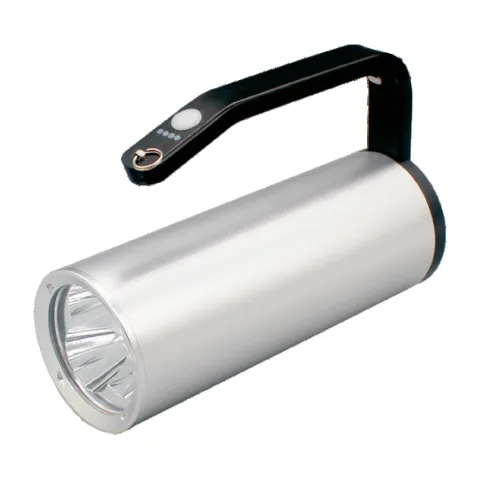
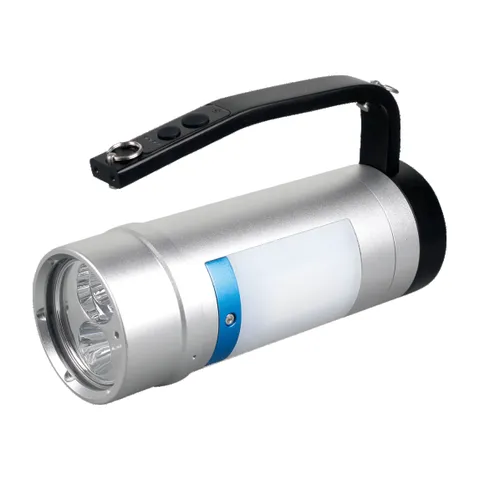
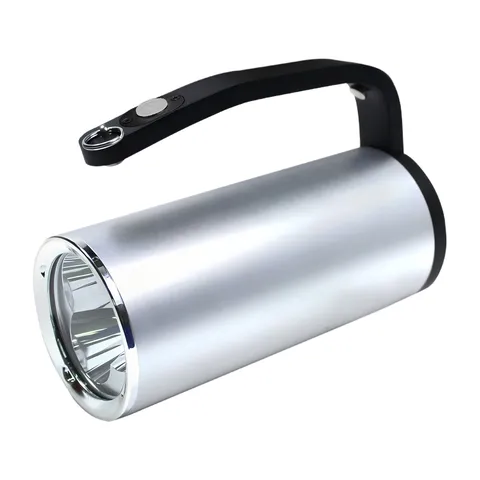
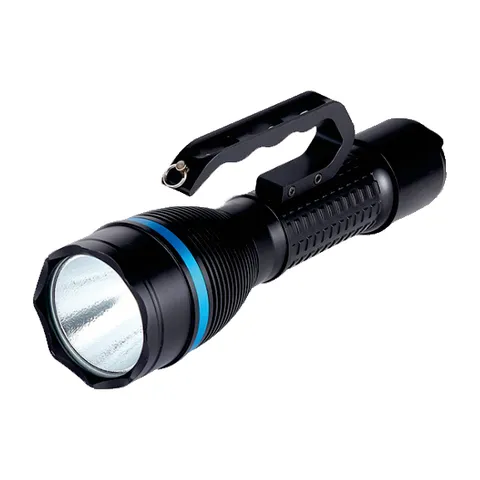
A flashlight lights what is in front of you. A searchlight finds what is far away: a valve at the top of a column, a person in the water beside a jetty, a leak on a pipe rack thirty metres up, a damaged insulator on a tower. In a refinery, a tank farm or on an offshore deck, that searchlight also has to be safe in a flammable atmosphere. That combination of long throw, high power and explosion protection is what makes hazardous-area searchlights different from both ordinary searchlights and explosion-proof flashlights.
This guide covers how to read the marking, how to compare beam performance properly, which beam layout suits which job, and what to check on battery, weight and sealing before you order.
Why explosion-proof searchlights are usually flameproof
Small flashlights and headlamps can be made intrinsically safe (Ex i) because a 3W LED and a single cell can be energy-limited. A searchlight that throws a usable beam a hundred metres or more needs 9W to 24W or more and a high-voltage battery pack. That much energy cannot practically be limited, so the housing does the work instead: a flameproof enclosure (Ex d) that can contain an internal explosion and cool any escaping gas.
Most hand-held models therefore carry a combined marking such as:
Ex db ia IIC T6 Gb
| Part | Meaning for a searchlight |
|---|---|
| db | Flameproof enclosure around the battery and LED driver |
| ia | Intrinsically safe circuits, typically for parts that cannot sit inside the flameproof housing, such as switches or charging contacts |
| IIC | Covers all gas groups, including hydrogen and acetylene |
| T6 | Maximum surface temperature 85 °C, so it covers every temperature class |
| Gb | Suitable for Zone 1 and Zone 2 |
All six of our hand-held explosion-proof searchlights, from the HZ7101 to the HZ7106C, carry exactly this marking. For the difference between the two protection methods, see intrinsically safe vs flameproof; for the full marking, how to read an Ex marking.
Flameproof housings have one practical consequence: weight. Expect 0.7 to 1.6 kg for a hand-held unit, against 100–300 g for an intrinsically safe flashlight.
Beam distance: compare candela, not watts or lumens
Watts describe power drawn, and lumens describe total light. Neither tells you how far a beam reaches. What decides throw is peak beam intensity, measured in candela (cd), which depends on the LED and above all on the reflector or lens that concentrates the light.
The ANSI FL1 standard defines beam distance as the distance at which the light falls to 0.25 lux, roughly full moonlight. That gives a simple relationship:
Beam distance (m) = 2 × √candela
| Peak intensity | ANSI FL1 beam distance | What you can do with it |
|---|---|---|
| 2,500 cd | 100 m | Check equipment across a process unit |
| 10,000 cd | 200 m | Inspect the top of columns and flare stacks; search a tank farm |
| 40,000 cd | 400 m | Search water from a jetty or a deck; inspect transmission towers |
Two practical notes. First, 0.25 lux is enough to see that something is there, not to read a label. For inspection work, assume a useful range of about half the rated beam distance. Second, quadrupling candela only doubles the distance, so a light rated at twice the watts of another will not reach twice as far. When comparing quotations, ask for candela and beam distance measured to ANSI FL1, in the same mode.
Spot, flood or both
A pure spot beam is good for distance and bad for everything else: walking with a narrow beam is tiring and unsafe because you see the target but not the ground. That is why modern explosion-proof searchlights add flood panels. Our range covers four layouts:
| Layout | Best for | Example |
|---|---|---|
| Single spot | Patrols where the job is to see far, carried as a second light | HZ7101 (3 × 5W), HZ7102 (3 × 3W), HZ7103 (12W) |
| Spot plus side flood | One light for both searching and working, such as leak response or night repairs | HZ7106A: 12W spot plus two 6W flood panels |
| Twin spot plus flood | Maximum throw for search and rescue, water search, tower inspection | HZ7106B: 2 × 12W spot plus two 6W flood panels |
| Spot plus long economy mode | Standby lighting, long incidents, power cuts | HZ7109: 12W or 24W, up to 100 hours on economy |
Side flood panels that can light one side or both are more useful than they first seem. With one panel on, the searchlight can stand on the ground and light a work area while the spot stays off. With both on, it becomes an area light for a small team.
Laser and UV: special functions for inspection
The HZ7106C adds two tools to the normal spot and flood:
- A 90 mW laser pointer to show a colleague exactly which valve, flange or insulator you mean, at distances where hand signals and radio descriptions fail.
- A 12W, 365 nm UV lamp. Many oils, hydraulic fluids and leak-detection dyes fluoresce under UV-A, so small leaks show up as bright spots that are invisible in white light.
Lasers and other concentrated optical sources bring a specific ignition risk: the beam itself can heat a surface or a particle enough to ignite gas. That risk is covered by IEC 60079-28 on optical radiation. On any searchlight with a laser, confirm that the laser is included in the scope of the Ex certificate, not just the lamp body. Keep the laser for pointing and never aim it at people or into eyes.
Battery, runtime and charging
Searchlights use higher-voltage packs than flashlights to drive their LEDs efficiently. In our range:
- 22.2 V packs (HZ7103, HZ7106 series): five hours on high, ten hours on the working setting. The HZ7103 recharges in three hours, useful where lights are shared between shifts.
- 14.8 V (HZ7101): eight hours on high and sixteen on working, with a USB-C power-bank output for a phone or radio. On a long incident, a dead radio can matter as much as a dead light.
- Long economy modes (HZ7109): up to 100 hours on economy for standby duty.
As with all rechargeable explosion-proof lights, charge only outside the hazardous area unless the certificate says otherwise. Plan a charging station with the searchlights for each shift so they do not end up in a drawer half-charged.
Weight, handling and water
A searchlight is held at arm's length and aimed for minutes at a time, so balance matters as much as total weight. Before ordering in quantity, have users try a sample: the HZ7102 at 733 g suits regular patrols; the 1.3–1.6 kg twin-beam and multi-function models are better for occasional search work or when the light can be stood on the ground.
For water, look for a dual rating. Our HZ7103 and HZ7106 series are rated IP66 / IP68 (2 m, 1 h), meaning they have passed both a powerful water-jet test and a submersion test. That matters for jetties, decks and fire-fighting water. A light marked only IP68 has not necessarily passed the jet test; see our IP rating guide for why.
Explosion-proof searchlight comparison
| Model | Light source | Runtime (high / work) | Charge | IP | Weight |
|---|---|---|---|---|---|
| HZ7101 | 3 × 5W LED | ≥8 h / ≥16 h | ≤8 h, USB-C, power bank | IP68 (2 m, 1 h) | 892 g |
| HZ7102 | 3 × 3W LED | ≥8 h / ≥16 h | ≤8 h | IP68 | 733 g |
| HZ7103 | 12W LED | ≥5 h / ≥10 h | ≤3 h | IP66 / IP68 | 1.4 kg |
| HZ7106A | 12W spot + 2 × 6W flood | Spot ≥5 h / ≥10 h | ≤6 h | IP66 / IP68 | 1301 g |
| HZ7106B | 2 × 12W spot + 2 × 6W flood | Spot ≥5 h / ≥10 h | ≤6 h | IP66 / IP68 | 1288 g |
| HZ7106C | 12W spot + flood, laser, UV | Spot ≥5 h / ≥10 h; UV ≥6 h | ≤6 h | IP66 / IP68 | 1386 g |
| HZ7109 | 12W or 24W LED | ≥5–6 h / ≥10–12 h; economy ≥100 h | ≤3 h | IP66 / IP68 | 1605 g |
All models except the HZ7109 are marked Ex db ia IIC T6 Gb. The HZ7109's marking is supplied with its certificate on request.
Which searchlight for which job
- Refinery and chemical plant patrols: HZ7102 or HZ7101 as a personal searchlight, alongside a headlamp.
- Leak response and maintenance at night: HZ7106A, using the spot to find the problem and the flood to work on it.
- Leak detection rounds: HZ7106C, with UV for oil and fluid leaks and the laser to point them out.
- Fire and rescue, water search, ports: HZ7106B for maximum throw, with its IP66 / IP68 rating for spray and immersion.
- Shared lights on 24-hour operations: HZ7103, because of its three-hour charge.
- Power cuts and standby duty: HZ7109, for its 100-hour economy mode.
Common mistakes
- Comparing watts. Ask for candela and ANSI FL1 beam distance in the same mode.
- Buying a pure spot for general use. Users end up carrying a second light to walk with. Spot plus flood is usually the better buy.
- Ignoring the laser in the certificate. Check that optical sources are included in the Ex certification.
- Choosing on weight alone. A light that is 200 g lighter but has half the runtime will run out during a long incident.
- Accepting "IP68" without a jet rating. Searchlights get hosed down and splashed far more often than they are submerged.
Sample specification for a tender
- Hand-held searchlight, marked Ex db ia IIC T6 Gb or equivalent, with a certificate under the scheme the site accepts (IECEx, ATEX or national).
- Peak intensity at least [X] cd and ANSI FL1 beam distance at least [Y] m on high.
- Spot and flood output, flood switchable on one or both sides.
- Runtime at least 5 hours on high and 10 hours on the working setting.
- Ingress protection IP66 / IP68, immersion depth and duration stated.
- Weight not more than [Z] kg; carry handle and shoulder strap.
- Any laser or UV source included in the scope of the Ex certificate.
Tell us the application, the zone and how far you need to see through the inquiry form, and we will recommend a model and send a quotation. All searchlights are available under your brand through our OEM service.
Frequently asked questions
How far can an explosion-proof searchlight see?
It depends on peak intensity, not watts. Under ANSI FL1, beam distance in metres is about 2 × the square root of the candela figure: 10,000 cd gives about 200 m. Ask for candela and beam distance in the same mode when comparing.
Why are explosion-proof searchlights heavier than flashlights?
Their LEDs need more power than intrinsic safety can allow, so they use a flameproof (Ex d) housing that can contain an internal explosion. That housing adds weight, typically 0.7–1.6 kg for a hand-held unit.
What does Ex db ia IIC T6 Gb mean on a searchlight?
A flameproof enclosure (db) with intrinsically safe circuits (ia), tested for all gas groups (IIC), with surface temperature below 85 °C (T6), approved for Zone 1 and Zone 2 (Gb).
Is a laser allowed on an explosion-proof searchlight?
Yes, if the laser is included in the scope of the Ex certificate. Optical radiation can ignite gas, so it is assessed under IEC 60079-28. Check the certificate covers the laser, not just the lamp.
What is UV light on a searchlight used for?
365 nm UV makes many oils, hydraulic fluids and leak-detection dyes fluoresce, so small leaks show up clearly at night.
Further reading
- IECEx: International Electrotechnical Commission System for Certification to Standards Relating to Equipment for Use in Explosive Atmospheres
- European Commission: Equipment for potentially explosive atmospheres (ATEX)
Need lights for a project? Send the zone, gas group and quantities and we will suggest models and a price.
Get a quote