Almost every industrial light is sold with an IP rating, and almost every buyer compares them as a simple ladder: IP68 beats IP67, IP67 beats IP66. That is not how the ratings work. An IP68 light has passed a submersion test, but not necessarily a water-jet test. An IP66 light can be hosed down every shift but may leak if it is dropped into a sump. Choosing the wrong one means water in the battery compartment, corroded contacts and lights that fail just when they are needed.
This guide explains what each part of the IP code means, what the tests behind IP65 to IP68 actually involve, and how to pick the right rating for the places your lights will go.
How to read an IP code
IP stands for "ingress protection". The code is defined in the international standard IEC 60529 and has two digits, sometimes followed by a letter:
IP 6 6
- First digit (0–6): protection against solid objects and dust.
- Second digit (0–9): protection against water.
- An "X" in place of a digit means that property was not tested or not specified. IPX7, for example, says nothing about dust.
For industrial lighting, only the top of each scale really matters.
| First digit | Meaning | Test in brief |
|---|---|---|
| 4 | Protected against objects over 1 mm (wires, small screws) | 1 mm probe must not enter |
| 5 | Dust-protected | Some dust may enter, but not enough to affect operation or safety |
| 6 | Dust-tight | No dust enters after hours in a talc-powder chamber under partial vacuum |
| Second digit | Meaning | Test in brief |
|---|---|---|
| 4 | Splashing water | Water splashed from all directions |
| 5 | Water jets | 6.3 mm nozzle, 12.5 L/min, from 2.5–3 m, at least 3 minutes |
| 6 | Powerful water jets | 12.5 mm nozzle, 100 L/min, from 2.5–3 m, at least 3 minutes |
| 7 | Temporary immersion | Submerged with the lowest point 1 m deep for 30 minutes |
| 8 | Continuous immersion | Deeper or longer than IPX7, under conditions the manufacturer must state |
| 9 (9K) | High-pressure, high-temperature jets | Close-range hot water at high pressure, as in vehicle or food-plant washdown |
What each rating means on a real site
The tests are laboratory conditions. Translated into site conditions, and with examples from our range:
| Rating | Handles | Does not handle | Examples |
|---|---|---|---|
| IP54 | Dust, splashes, light rain | Hosing down, heavy rain, immersion | HZ6610 slim inspection light, for dry vessel and pipe-rack inspection |
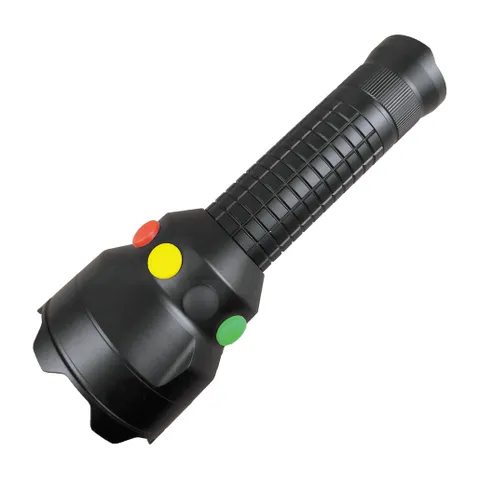
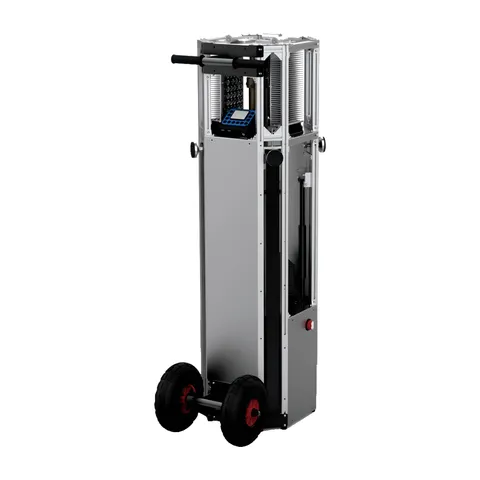
| IP65 | Dust-tight; rain and low-pressure hosing | Powerful jets, wave wash, immersion | HZ4730 railway signal flashlight, HZ6133 light tower |
| IP66 | Driving rain, deck wash, washdown with a fire hose | Being dropped into water | Most of our flashlights and headlamps, such as the HZ7623 and HZ5130 |
| IP67 | Short submersion up to 1 m: puddles, flooded ground | Jets (unless dual-rated), deep water | HZ4863C solar warning post |
| IP68 | Submersion beyond 1 m, for the stated depth and time | Jets (unless dual-rated) | HZ7101 (2 m, 1 h), HZ7211 (50 m, 1 h) |
Why IP68 is not "better" than IP66
This is the most common misunderstanding. The tests for the second digit are not cumulative above 6. IEC 60529 treats immersion (7 and 8) and jets (5 and 6) as different kinds of stress. A product marked only IPX7 or IPX8 has not been shown to resist water jets and need not meet the IPX5 or IPX6 requirements.
The difference is real. Immersion applies steady, gentle pressure. A jet hits one spot hard, can force water past a lip seal or a switch boot that holds perfectly well under still water, and can do it from any angle. A light that will be both hosed down and occasionally dropped in water needs to pass both tests, and the way to show that is a dual rating, written as IP66/IP68 or IP66/IP67.
Our hand-held searchlights carry dual ratings for exactly this reason: the HZ7106A, HZ7106B and HZ7103 are rated IP66 / IP68 (2 m, 1 h), and the new HZ7109 hand lamp is rated IP66 / IP68. If a datasheet shows only IP68, ask whether the product has also passed the IPX6 jet test.
IP68 means nothing without depth and time
IPX7 has a fixed test: 1 m for 30 minutes. IPX8 does not. The standard only requires conditions more severe than IPX7, agreed between the manufacturer and the user. One "IP68" light may have been tested at 1.5 m for one hour, another at 50 m. Both are honestly IP68.
So a useful IP68 claim always states the conditions. Across our range they vary widely:
- HZ5133B/C headlamp: IP66 / IP68 at 1.5 m for 1 hour. Enough for a fall into a flooded pit.
- HZ7307 and HZ7302A flashlights: IP66 / IP68 at 5 m for 2 hours. Suits ballast tanks and harbour work.
- HZ7211 flameproof flashlight: IP68 at 50 m for 1 hour, for diving support and flooded-shaft work.
When comparing quotations, write the depth and time into the specification. "IP68" alone lets every supplier quote their cheapest seal.
IP rating and explosion protection are separate
An IP rating says nothing about ignition. An IP68 flashlight without an Ex marking must not be taken into Zone 1 or Zone 2, however well sealed it is. Equally, an explosion-proof light with a low IP rating may be safe in gas but fail in the rain. You need both, chosen independently. See how to read an Ex marking for the gas side.
The two do meet in a few places:
- Dust protection by enclosure (Ex t) relies on the enclosure keeping dust out, so it comes with minimum IP requirements: typically dust-tight IP6X for conductive dusts and for Zone 21.
- Other Ex protection types also set minimum IP levels for their enclosures, which the certificate records.
- The Ex certificate often states the IP rating that was verified during certification. Use that figure rather than a brochure claim.
What IP ratings do not test
IP covers dust and fresh water at room temperature. Several things that destroy lights on industrial sites are outside its scope:
| Hazard | Covered by IP? | What to ask for instead |
|---|---|---|
| Salt spray and sea air | No (tests use fresh water) | Housing material, coating, stainless fasteners, salt-spray test results |
| Oils, solvents, cleaning chemicals | No | Chemical compatibility of the housing and seals |
| Impact and drops | No | IK rating (IEC 62262) or drop-test height |
| Steam cleaning, high-pressure washers | Only IPX9 / 9K | IPX9K if lights are pressure-washed at close range |
| Cold, heat, UV | No | Operating temperature range, UV-stabilised lens material |
Offshore buyers in particular should treat IP66 as the starting point and then check corrosion resistance separately.
Keeping the rating in service
An IP rating describes a new, correctly assembled product. On site, the seal is only as good as its last battery change. In the field, most water damage comes from handling rather than from the design:
- Close tail caps and charging covers fully. A rubber USB-C cover left half open turns an IP68 light into an IP54 one.
- Check O-rings when opening a light to change batteries. Replace cracked or flattened seals and keep them lightly greased with silicone grease if the manual allows.
- Never open a light in the rain or in a wet area; do it in the workshop and dry it first.
- Watch for thermal breathing. A light that has been running hot and is then dropped into cold water cools quickly, and the falling internal pressure can pull water past a marginal seal. That is another reason to choose dual-rated lights for marine work.
- Rinse lights with fresh water after offshore or chemical exposure, and dry them before charging.
For explosion-proof lights, any work on seals and housings must follow the manufacturer's instructions, because the seals can also be part of the Ex protection.
Choosing the right rating by application
| Application | Typical exposure | Recommended minimum |
|---|---|---|
| Indoor plant, dry inspection | Dust, occasional splashes | IP54 |
| Refinery and chemical plant, outdoor rounds | Rain, washdown | IP66 |
| Mining and tunnelling | Dust, dripping water, slurry, drops into puddles | IP66 / IP67 or IP66 / IP68 |
| Tank cleaning and confined spaces | Jets during cleaning, standing water | IP66 / IP68 |
| Fire and rescue | Fire-hose spray, flood water | IP66 / IP68 |
| Ports, ships and offshore | Green water, deck wash, falls overboard | IP66 / IP68 with stated depth, plus corrosion resistance |
| Railway and power line warning | Rain, wind-driven rain for years outdoors | IP65 or higher |
For confined spaces in particular, see our tank and confined-space lighting guide.
IP and NEMA: a rough comparison
North American specifications often use NEMA enclosure types instead of IP codes. NEMA types also cover things IP does not, such as corrosion and ice, so there is no exact conversion and the comparison works only one way (a NEMA type meets at least the IP rating shown, not the reverse):
| NEMA type | Roughly meets |
|---|---|
| 4 | IP66 |
| 4X | IP66, plus corrosion resistance |
| 6 | IP67 |
| 6P | IP68, plus corrosion resistance |
How to write the IP requirement in a tender
Ambiguous IP wording is one of the easiest ways to receive quotes that cannot be compared. Use wording like this:
- "Ingress protection IP66 / IP68 to IEC 60529, immersion tested at [depth] m for [time] hours."
- "IP rating to be stated on the Ex certificate or a third-party test report."
- "Charging port and battery compartment to maintain the rating when closed; describe the sealing method."
- For offshore: "Housing and fasteners suitable for marine atmosphere; state materials and any salt-spray test."
Not sure which rating your site needs? Send us the application, the zone and the conditions through the inquiry form and we will recommend models with the right IP and Ex combination. Ask us for the test documents behind any rating you need to submit. For OEM orders, the sealing specification stays the same under your brand.
Frequently asked questions
Is IP68 better than IP66?
Not necessarily. IP68 means the light passed a submersion test; IP66 means it passed a powerful water-jet test. They test different things, and an IP68-only light may not resist jets. For both, look for a dual rating such as IP66/IP68.
What does IP68 depth mean?
IEC 60529 leaves IPX8 test conditions to the manufacturer, as long as they are more severe than IPX7 (1 m for 30 minutes). A proper IP68 claim states the depth and time, for example 2 m for 1 hour.
Can an IP68 light be used in a hazardous area?
Only if it also carries a suitable Ex marking and certificate. The IP rating covers dust and water, not ignition.
What IP rating do I need for offshore use?
IP66 as a minimum for deck washdown and spray, and IP66/IP68 with a stated depth if lights can fall overboard or into flooded spaces. Check corrosion resistance separately, because IP tests use fresh water.
Does a dust-tight IP6X light keep out water?
No. The first digit only covers solids and dust. Water protection is given by the second digit.
Further reading
- IEC: Ingress Protection (IP) ratings, IEC 60529
- IECEx: International Electrotechnical Commission System for Certification to Standards Relating to Equipment for Use in Explosive Atmospheres
Need lights for a project? Send the zone, gas group and quantities and we will suggest models and a price.
Get a quote