Fixed signals and radios carry most railway communication, but hand signals have never gone away. Shunting moves in a yard, pilotman working during a signal failure, protecting a work site on the line, marking a train under repair, or guiding a driver up to a loading rack at night: all of these still depend on a person holding a light. If that light shows the wrong colour, shows a weak colour, or dies at four in the morning, the consequences can be serious.
This guide covers how to choose hand signal lamps and position lights for railway operators, track contractors and industrial sidings: which colours you need, what makes a colour reliable, how long the lamps must run, and what changes when the work is inside a hazardous area.
Start with the rule book, not the catalogue
Every railway publishes a rule book that defines which hand signals exist, which colours they use and what movements go with them. The colours below are the most common, but the meaning of each, and whether white or blue is used at all, varies between countries and even between operators.
| Colour | Typical meaning | Notes |
|---|---|---|
| Red | Stop, danger | Universal. Any lamp used for protection must be able to show red. |
| Yellow / amber | Caution, reduce speed | Common in Asian and European rule books. |
| Green | Proceed, all right | Used in most systems; replaced by white motions in some. |
| White | Movement signals given by motion of the light; general lighting | In some North American practice, most hand signals are given with a white light moved in set patterns. |
| Blue | Workers are on, under or between equipment: do not move it | In the US, defined in 49 CFR 218.5 as a blue flag or blue light by day and a blue light at night. |
So the first step is to list the colours your rule book requires and choose a lamp configuration that provides exactly those. A lamp with a colour your staff are not supposed to use is a source of confusion; a lamp missing a colour they need is useless.
Signal lamp configurations
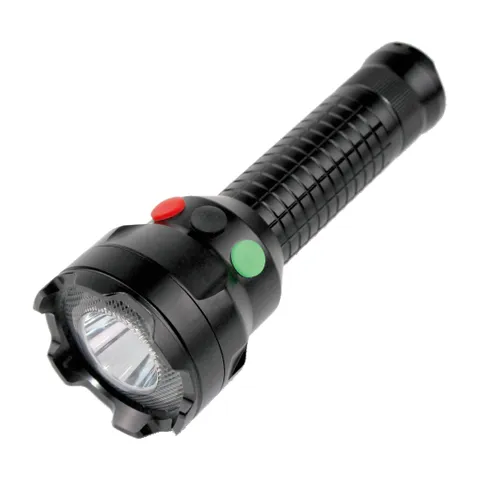
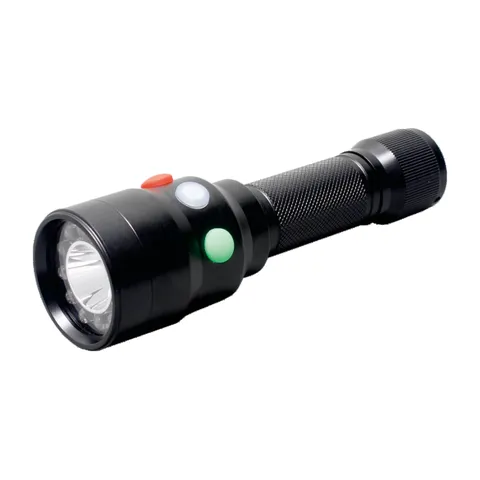
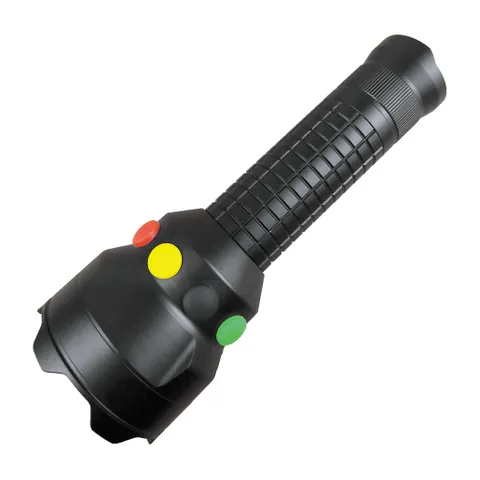
Our signal flashlights come in three colour configurations so that each railway can match its rule book:
- Red-yellow-white (HZ4720, HZ4720A): for systems that use red and yellow hand signals, with white for lighting and motion signals.
- Red-green-white (HZ4720, HZ4720A): for systems that use red and green.
- Four colours: red, yellow, green and white (HZ4730): for operators whose rule book uses all three signal colours, or for contractors who work on several networks.
Each lamp also works as an ordinary 3W flashlight in white, so the signaller does not need to carry a second light for walking the track or checking couplings.
Colour quality: a weak red is a dangerous red
A signal colour has to be recognised instantly, at a distance, in rain, through a dirty windscreen and by drivers with ordinary variations in colour vision. Two things matter:
- Saturation. A pale or pinkish red can be read as white or yellow at distance. International guidance on signal colours, such as CIE S 004 (Colours of light signals), defines the colour regions that signal lights should fall within. Ask whether the lamp's colours are designed to that kind of standard.
- Intensity in each colour. Coloured filters absorb light; a lamp that is bright in white may be dim in green. Compare lamps in signal mode, not torch mode, and test them outdoors at night at the distances your staff actually signal over.
Test new lamps before a fleet order: stand at the distance of a typical shunting move, in darkness and at dusk, and check that each colour is unmistakable, including to someone who has not been told what to expect.
Runtime and the length of a railway shift
Railway shifts often run 10 to 12 hours, and track possessions can overrun. A signal lamp needs to cover the whole shift in signal mode with margin, and still have white light for the walk back.
| Model | Colours | Runtime | Charge | Weight |
|---|---|---|---|---|
| HZ4720 | R-Y-W or R-G-W | Signal ≥12 h; white high ≥10 h, work ≥20 h | ≤8 h, 5000 mAh | 292 g |
| HZ4720A | R-Y-W or R-G-W | Signal ≥12 h; white high ≥8 h, work ≥16 h | ≤5 h, 2200 mAh | 237 g |
| HZ4730 | R, Y, G, W | Signal ≥12 h; white high ≥10 h, work ≥20 h | ≤8 h, 5000 mAh | 290 g |
The HZ4720A trades some capacity for lower weight and a faster charge, which suits staff who carry a lamp all shift but signal only occasionally. The HZ4720 and HZ4730 suit shunters and possession staff who signal continuously.
One-hand use, gloves and getting to red quickly
Signallers often hold a radio in one hand and the lamp in the other, wear gloves in winter and need to change colour in the middle of a move. When trying sample lamps, check:
- Can the colour be changed with one gloved hand, without looking at the lamp?
- How many presses does it take to reach red from any other state? In an emergency, the stop signal should be the quickest to reach.
- Is the active colour obvious to the person holding the lamp as well as to the driver?
- Does the lamp have a lanyard or clip so it is not put down on the ballast?
Marking work sites and protected equipment
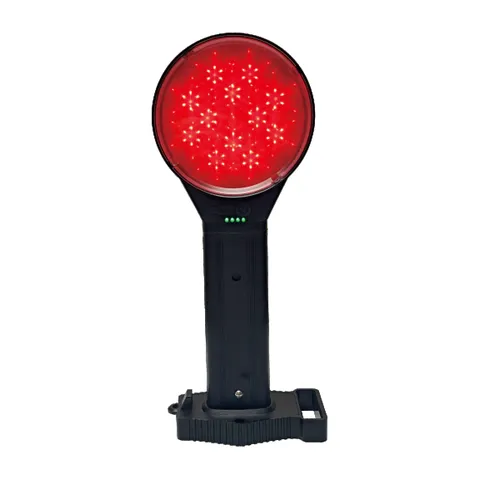
Hand lamps signal; position lights mark. Typical uses are marking the limits of a work site or possession, the ends of a train under repair, or a point where nothing may pass.
- HZ4830 and HZ4831: double-sided red position lights visible from both directions, running 30 hours or more in flash mode. The HZ4830 has a telescopic handle to raise the light above ballast and rail height.
- HZ4800: a small position light available in red, yellow, blue or green that runs 100 hours on two AAA cells. It is explosion-proof (Ex ib IIC T4 Gb), which matters at fuel and chemical loading racks; see below.
- HZ4801: a 12 g red-blue light that clips to a helmet or vest so track workers are visible to each other and to machine operators.
Signalling inside hazardous areas
Tank-car loading racks, fuel depots, refinery sidings and chemical plant railways are often classified as hazardous areas. A standard signal lamp or position light taken into those zones is an ignition source. For work inside them:
- Use an explosion-proof position light such as the HZ4800 for marking and blue-signal protection inside the classified area.
- Give signallers an explosion-proof flashlight as their white light inside the zone, such as the HZ7623 (Ex ib IIC T4 Gb), and do coloured signalling from outside the zone boundary where the site rules allow.
- Check the zone, gas group and temperature class with the site before issuing any light; our zone guide explains how.
If your operation needs coloured hand signals given from inside a classified area, tell us. It is a specific requirement that we can discuss on a project basis.
Weather, charging and fleet management
- Weather. Our signal lamps and position lights are rated IP65: dust-tight and protected against rain and water jets from any direction. For lamps that are hosed down or used in very wet cuttings and tunnels, see our IP rating guide.
- Charging. A depot with dozens of lamps needs a charging routine, not a drawer of cables. The HZ1110 charging case charges up to 10 lights at once from mains or a 12–36 V vehicle supply, so a track gang's lamps can be charged in the van between sites. Confirm charger compatibility for each lamp model in your order.
- Numbering and checks. Number every lamp, keep a sign-out sheet, and check all colours at the start of each shift. A lamp with a cracked lens or a missing colour is withdrawn, not used "just for white".
Checklist for a fleet order
- Colours required by your rule book, and the configuration that matches them.
- Colour quality: saturation and intensity in each signal colour, checked outdoors at night.
- Runtime in signal mode of at least one full shift, plus white light.
- One-hand, gloved colour change; quickest path to red.
- IP65 minimum; higher for very wet locations.
- Position lights for work-site limits, and Ex-rated lights for any hazardous loading areas.
- Charging solution for the depot and vehicles.
- Labelling and private branding if lamps are issued under your company name.
Send us your rule book colours, the number of staff per shift and any hazardous locations through the inquiry form, and we will put together a lamp and charging package. Lamps are available with your logo through our OEM service.
Frequently asked questions
Which colours should a railway hand signal lamp have?
The colours your rule book uses. Red is universal; yellow, green, white and blue depend on the railway. We offer red-yellow-white, red-green-white and four-colour versions.
What does a blue light mean on a railway?
In US practice it protects workers: under 49 CFR 218.5 a blue signal is a blue flag or light by day and a blue light at night, meaning workers are on, under or between equipment, which must not be moved.
How long should a signal lamp run?
At least one full shift in signal mode with margin, typically 12 hours, plus white light for walking. Our signal flashlights run 12 hours or more in signal mode.
Can I use a normal signal lamp at a fuel loading rack?
Not inside a classified hazardous area. Use explosion-proof lights there, such as the HZ4800 position light (Ex ib IIC T4 Gb), and follow the site's zone rules.
How do we charge lamps for a track gang?
Use a multi-slot charging case that runs from mains and a vehicle supply. The HZ1110 charges up to 10 lights from AC 220 V or 12–36 V DC.
Further reading
Need lights for a project? Send the zone, gas group and quantities and we will suggest models and a price.
Get a quote