A turnaround packs months of maintenance into a few weeks of round-the-clock work. Hundreds of contractors open exchangers, enter columns, change valves and inspect welds, much of it at night. Lighting is easy to underestimate in the plan and expensive to fix once the work has started: crews waiting for lights, temporary cables across walkways, borrowed non-rated lamps inside the unit, and lights going flat at three in the morning because nobody planned the charging.
This guide sets out a practical lighting plan for refinery, petrochemical and chemical plant turnarounds and shutdowns, from zone mapping to the charging room.
Step 1: map which areas stay hazardous
A shutdown unit is not automatically a safe area. Neighbouring units usually keep running, flare and drain systems stay connected, and equipment is only gas-free once it has been isolated, purged and tested. Lines are opened and residues disturbed throughout the job.
- Start from the site's hazardous area classification drawings and assume every classified area stays classified unless the permit system formally says otherwise.
- Note the zone, gas group and temperature class for each work front. These decide which lights may be used there.
- Mark where hazardous-area rules do not apply (laydown yards, contractor villages, warehouses), where cheaper non-rated lights can be used.
As a planning default, specify explosion-protected lights for Zone 1, gas group IIC, for everything that will be used inside the unit fence. It removes the risk of the wrong light ending up in the wrong place. See our zone guide for background.
Step 2: plan lighting in layers
| Layer | What it does | Typical equipment |
|---|---|---|
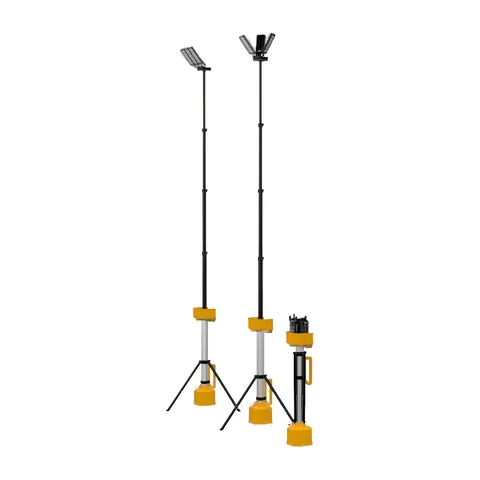
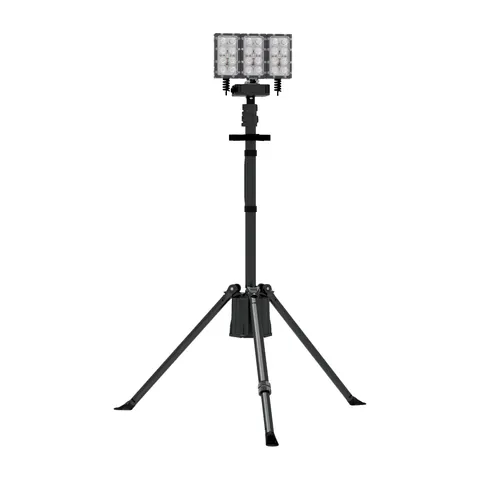
| Area lighting | Lights the work front, access routes and laydown so people can move safely | Explosion-proof tripod systems: HZ6129 (180W, 3.8 m), HZ6125 (100W, 2.2 m) |
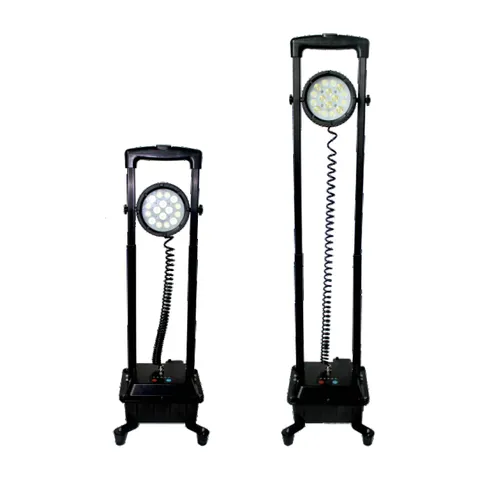
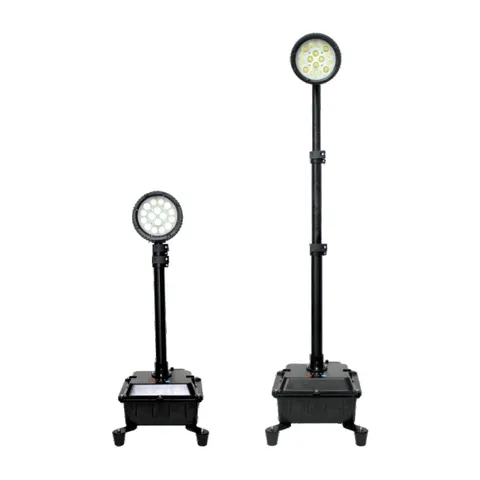
| Task lighting | Puts light on a flange, a bundle or a weld | Explosion-proof work lights: HZ6103 and HZ6105 (50W on a mast), HZ5282 (12W, up to 80 h on low) |
| Personal lighting | Lets each worker see their own work and find the way out | Headlamps such as the HZ5130; flashlights such as the HZ7623 |
| Inspection lighting | Close visual inspection of welds, internals and corrosion | HZ6601 inspection light; searchlights for high points |
| Confined-space lighting | Area and escape lighting inside vessels and columns | See our confined-space lighting guide |
Planning in layers stops two common failures: area lighting that leaves the actual job in shadow, and personal lights used as the only light, so people cannot see where they are walking.
Step 3: how much light, and how many lights
Use your company standard if it sets lux levels. If not, OSHA 1926.56 gives useful minimums: 5 foot-candles (about 54 lux) for general construction areas, rising to 10 foot-candles (about 108 lux) for plants and shops. Treat these as the floor for access routes and general areas; detailed mechanical work and inspection need much more at the work surface, which comes from task and personal lights.
For quantities, work from the work-front list rather than square metres:
- Area lights: one tripod system per work front, plus one for each main access route and stair tower that lacks permanent lighting. A 3.8 m system such as the HZ6129 is rated at 600 lux at 10 m and can light 360° or one side.
- Task lights: one per active job that needs light in a fixed position for more than an hour, such as bolting, bundle pulls or welding preparation.
- Personal lights: one headlamp per worker on shift, plus about 20% spares to cover charging, losses and damage.
- Inspection lights: one per inspector or QA/QC engineer.
Step 4: battery or cabled temporary lighting
Traditional turnaround lighting uses cabled floodlights fed from temporary distribution boards. It gives unlimited runtime but brings its own problems in a hazardous area: Ex-rated cable glands and junction boxes, cable routes across walkways and through manways, inspection of every connection, and time to move lights when the work moves.
Battery lighting has improved enough to change that balance. A modern explosion-proof tripod system sets up in a minute, moves with the work front and puts nothing on the ground. Most turnarounds now use a mix:
- Cabled or permanent for fixed, long-duration areas: main access routes, laydown, workshops.
- Battery for work fronts that move, elevated platforms, confined spaces and anywhere cables would cross a walkway or block an exit.
Step 5: plan runtime and charging before the first shift
Battery lighting only works if charging is organised. Most failures on the night shift come from charging, not from the lights.
- Match modes to shift length. On a 12-hour night shift, run an HZ6129 on flood or spot only (13 hours or more) rather than all heads (7 hours or more), or plan a swap halfway through. Headlamps and flashlights with 16-hour working modes cover a full shift.
- Set up a charging room outside the hazardous area, with enough sockets for every light to recharge between shifts. Most of our lights recharge in 3 to 8 hours, so two-shift operation works if each light goes straight onto charge when it comes back.
- Use multi-slot charging cases for handheld lights: an HZ1110 charges up to 10 at once. Check compatibility with each model in your kit.
- Number every light and run a simple sign-out and sign-in log. It cuts losses and shows which lights are not coming back charged.
- Never charge in the field. Charging, opening or repairing explosion-proof lights inside the hazardous area breaks most certificate conditions.
Step 6: inspection and control on site
- Check every light on issue: housing, lens, seals, markings, battery level.
- Quarantine damaged lights immediately. Repairs to explosion-proof equipment must follow the manufacturer's instructions; IEC 60079-17 covers inspection and maintenance of equipment in hazardous areas.
- Remove any non-rated light found inside the unit. Brief contractors at induction on which lights are allowed and where to get them.
- Lights do not replace gas testing. Hot work, vessel entry and line breaking still follow the permit and gas-test regime.
Sample kit for a 40-person night shift
A medium process unit with four work fronts (exchanger bay, column base, pump row, pipe rack), two vessel entries and two inspectors:
| Item | Qty | Purpose |
|---|---|---|
| HZ6129 3.8 m tripod system | 4 | Area light at each work front, run on flood for a full 12-hour shift |
| HZ6125 2.2 m tripod system | 3 | Stairs, access routes, smaller jobs |
| HZ6103 / HZ6105 50W work light | 6 | Bolting, bundle pulls, weld preparation |
| HZ5282 12W portable light | 4 | Area and escape lighting inside the two vessels |
| HZ5130 headlamp | 48 | One per worker plus 20% spares |
| HZ7623 flashlight | 20 | Supervisors, permit issuers, fire watch |
| HZ6601 inspection light | 4 | Inspectors and QA/QC |
| Charging cases and sockets | As needed | Charging room outside the hazardous area |
Double the personal-light figures if day and night shifts do not hand lights over, and add area lights for any 24-hour laydown or assembly areas.
Buy or rent?
Rental suits a one-off shutdown. Sites and contractors that run several turnarounds a year, or a long major turnaround, usually find buying cheaper over two or three events, and get lights they know are maintained. Maintenance contractors increasingly carry their own branded lighting kit from job to job. We supply complete kits under your brand through our OEM service.
Turnaround lighting checklist
- Hazardous area drawings reviewed; classified areas assumed to stay classified.
- Default specification: Zone 1, IIC, temperature class to suit the unit.
- Work-front list with area, task, personal, inspection and confined-space lighting for each.
- Lux targets set for routes and work surfaces.
- Battery and cabled lighting split decided.
- Runtime per mode matched to shift length; swap plan where needed.
- Charging room outside the hazardous area, with capacity for every light.
- Numbering, sign-out log, issue checks and quarantine procedure.
- Contractor induction covers lighting rules.
Send us your work-front list, shift pattern and hazardous area data through the inquiry form, and we will propose a complete lighting kit with quantities and a charging plan.
Frequently asked questions
Do I need explosion-proof lights during a shutdown?
Usually yes inside the unit. Neighbouring plant keeps running, equipment is only gas-free after isolation and testing, and residues release vapour during the work, so classified areas are normally treated as still classified.
How many headlamps do we need for a turnaround?
One per worker on shift plus about 20% spares for charging, losses and damage. Double that if day and night shifts do not hand lights over.
Battery or cabled lighting for a turnaround?
Most sites use both: cabled or permanent lighting for fixed routes and laydown, battery lighting for moving work fronts, elevated platforms and confined spaces where cables would block access.
How do we keep battery lights running on a 12-hour night shift?
Choose modes that last the shift, such as flood-only on area lights, plan a mid-shift swap where needed, and run a charging room outside the hazardous area so every light goes back on charge at the end of each shift.
How much light is needed on a work front?
As a minimum, OSHA 1926.56 gives about 54 lux for general construction areas and 108 lux for plants and shops. Detailed mechanical and inspection work needs much more at the work surface from task and personal lights.
Further reading
- OSHA 29 CFR 1926.56: Illumination
- IECEx: International Electrotechnical Commission System for Certification to Standards Relating to Equipment for Use in Explosive Atmospheres
Need lights for a project? Send the zone, gas group and quantities and we will suggest models and a price.
Get a quote