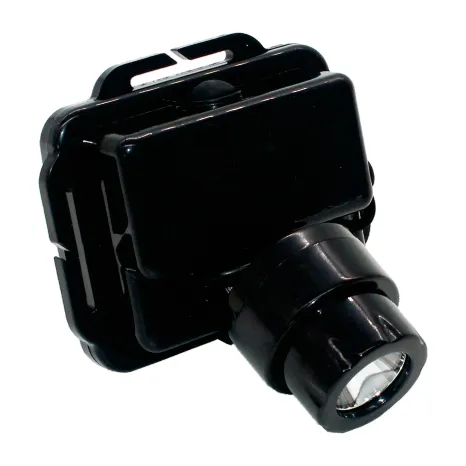
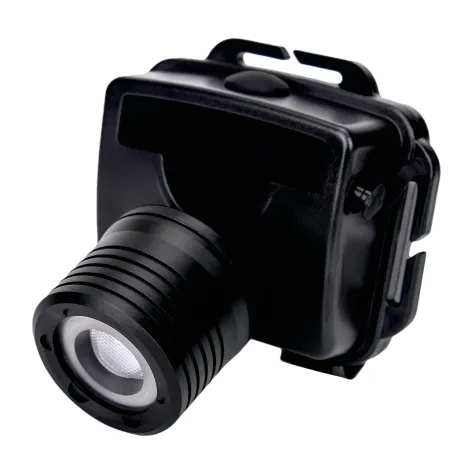
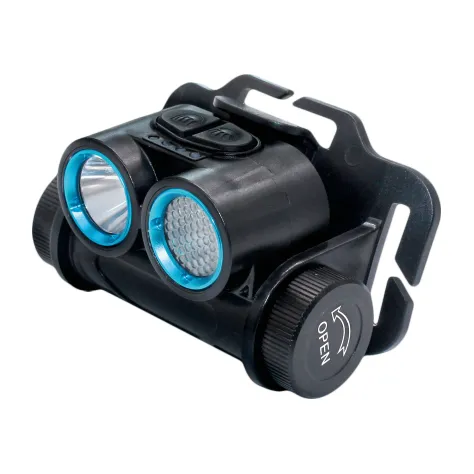
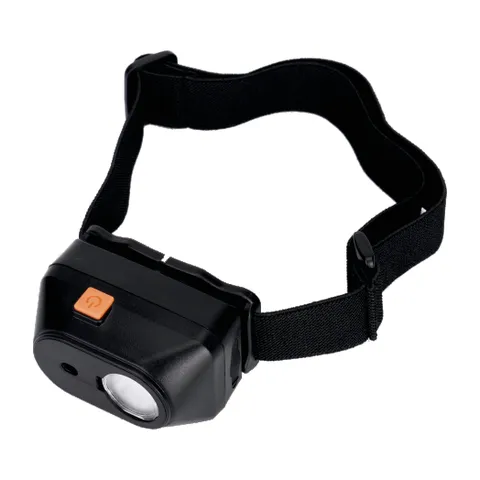
A headlamp is the light most people in a hazardous area actually use. A flashlight takes a hand; a work light stays where it is put. A headlamp follows the eyes, leaves both hands free for a ladder, a valve or a gas detector, and goes everywhere the wearer goes: into the pump house, up the pipe rack, down into the pit. That is also why it needs to be chosen with care. It crosses every zone on the site, it is worn for the whole shift, and it is the light a worker relies on to find the way out if area lighting fails.
This guide covers what to check, in the order a safety officer or buyer normally checks it: the Ex marking first, then runtime, beam, comfort and handling, and finally charging and fleet management.
Why explosion-proof headlamps are almost always intrinsically safe
Larger lights often use a flameproof housing (Ex d) that can contain an internal explosion. That approach needs thick walls and machined joints, which is fine for a 10W hand lamp but far too heavy for something worn on the head. Headlamps therefore use intrinsic safety (Ex i): the circuit limits electrical and thermal energy so that neither a spark nor a hot component can ignite the gas. A single lithium cell and a 3W LED can be energy-limited in a housing that weighs under 100 g.
The consequence is that headlamp output is capped by physics and by the standard. Most intrinsically safe headlamps run a 3W LED, sometimes two. If a supplier offers a "Zone 1 headlamp" with the output of a 1,500-lumen camping headlamp, ask to see the certificate. For a deeper comparison of the two protection methods, see intrinsically safe vs flameproof.
Reading the marking on a headlamp
All six explosion-proof headlamps in our range carry the same marking:
Ex ib IIC T4 Gb
| Part | Meaning for a headlamp |
|---|---|
| ib | Intrinsic safety, level b: safe with one fault in the circuit. Suitable for Zone 1 and Zone 2. |
| IIC | Tested for the most easily ignited gas group (hydrogen, acetylene), so it also covers IIA and IIB. |
| T4 | Maximum surface temperature 135 °C. Accepted wherever T1–T4 is required. |
| Gb | Equipment protection level for Zone 1. Not allowed in Zone 0. |
Three practical points follow from this. First, a Gb headlamp covers Zone 1 and Zone 2 but not Zone 0. Zone 0 work, such as entry into a vessel that has not been gas-freed, needs Ga equipment (Ex ia). Second, T4 is enough for most hydrocarbons, but not all. A few substances have very low ignition temperatures; carbon disulfide, for example, requires T6. Check the temperature class on the site's area classification, not just the zone. Third, the "II" in IIC means surface industry. Underground coal mines need Group I equipment (EPL Ma or Mb) plus any national mining approval, so a Group II headlamp is for metal mines, tunnels, quarries and surface plants, not for coal faces. The full marking is explained in how to read an Ex marking.
Runtime: match it to the shift, not the brochure
Runtime figures are normally measured to ANSI FL1: the time until output falls to 10% of its starting value. A headlamp rated "8 hours on high" is well below its high output for the second half of that time. Use the figures to compare models, then check them against the real working pattern:
- 12-hour shifts need a working mode of at least 12 hours with margin. Our headlamps are rated at 16 hours or more on the working setting, such as the HZ5130 and HZ5133.
- Cold sites reduce lithium-ion capacity. If the lamp will be used below freezing, plan on noticeably less than the rated runtime and keep the headlamp under the hood between tasks.
- Mixed tasks are where dual-output lamps help. The HZ5135 has separate spot and flood LEDs and a 2600 mAh cell: up to 20 hours on low flood for close work, spot on high for looking across a tank farm.
Charging time matters as much as runtime for a pooled fleet. A headlamp that takes 8 hours to charge needs a full off-shift to recover, so a 24-hour operation needs at least two lamps per position, or a staggered charging rota.
Beam: spot, flood or both
The right beam depends on what the wearer looks at most of the time:
| Task | Beam | Example model |
|---|---|---|
| Reading gauges, valve tags and labels at arm's length | Flood, low glare | BAD308E with diffuser across the lens |
| Walking routes, checking pipe racks and overhead lines | Spot | HZ5130, HZ5133 |
| Both in one shift (maintenance, inspection rounds) | Separate spot and flood | HZ5135 dual-beam |
| Looking down into pits and under equipment | Tilting head plus flood | HZ5133 tilting head |
Glare is a real problem with headlamps: when two workers face each other, a narrow high-power spot blinds the other person. A flood setting or a diffuser makes close work and team tasks more comfortable, and it saves battery.
Comfort, weight and hard hat fit
Weight is felt over a full shift. Explosion-proof headlamps in the 90–110 g range, such as the 91 g BAD308E-T and the 93 g HZ5130, are comfortable for most wearers. Check, too, how the lamp attaches:
- Helmet clips or helmet band. Confirm the lamp fits the hard hats your workers already wear. Slotted helmets, full-brim helmets and helmets with face shields all fit differently. Send us the helmet model and we will check it.
- Head strap. For work without a helmet, or under a hood, an elastic strap that can be washed or replaced.
- Tilt. A head that tilts down lets the wearer light the work without bending the neck.
Any accessory that touches the lamp must not change its certified configuration. Straps and clips are normally fine; adding a third-party battery pack, lens or switch is not.
Gloves, pockets and accidental switching
Most hazardous-area work is done in gloves, often heavy chemical or cut-resistant ones. Small buttons are hard to find and press. Two features help:
- Wave-to-switch sensor. The HZ5133B/C switches on and off with a wave of the hand, so the wearer does not have to find the button with a gloved finger. It is also rated IP68 (1.5 m, 1 hour).
- Mode lock. A lamp that switches on in a pocket or a locker drains its battery and can come out flat at the start of a shift. The HZ5135 has a lock.
Water and dust protection
IP66 is the practical minimum for site work: dust-tight and protected against powerful water jets, which covers rain and washdown. IP68 adds protection against submersion and suits wet pits, ballast tanks or offshore decks. Remember that IP and Ex are separate ratings: an IP68 headlamp without an Ex marking is not allowed in a classified area, and an Ex headlamp with a low IP rating may not survive the conditions there.
Charging and battery rules
This is the most commonly broken rule with intrinsically safe lamps. The certificate for a rechargeable headlamp normally requires that it is charged, opened and serviced only outside the hazardous area. The charging socket and charger are not part of the protected circuit while charging. Set up charging stations in the control room, workshop or another safe area, and read any special conditions (marked "X" on the certificate) before issuing the lamps.
Other points for a fleet:
- Do not mix chargers between models unless the manual allows it.
- Withdraw lamps with cracked housings, damaged seals or swollen batteries. Repairs to certified equipment must follow the manufacturer's instructions.
- For shipping, lithium-ion headlamps travel under the dangerous-goods rules for lithium batteries contained in equipment. We prepare the documents for sea and air freight.
Explosion-proof headlamp comparison
| Model | Marking | LED / battery | Runtime (work mode) | Weight | Best for |
|---|---|---|---|---|---|
| HZ5130 | Ex ib IIC T4 Gb, IP66 | 3W / 2000 mAh | ≥16 h | 93 g | General issue, long shifts |
| HZ5133 | Ex ib IIC T4 Gb, IP66 | 3W / 2000 mAh | ≥16 h | 107 g | Close work, tilting head |
| HZ5133B/C | Ex ib IIC T4 Gb, IP66 / IP68 | 3W / 2000 mAh | ≥16 h | 98 g | Gloved work, wet areas |
| HZ5135 | Ex ib IIC T4 Gb, IP66 | 2 × 3W / 2600 mAh | Flood up to 20 h | 107 g | Inspection rounds, mixed tasks |
| BAD308E | Ex ib IIC T4 Gb, IP66 | 3W / 1500 mAh | ≥16 h | 93 g | Reading gauges, spot or flood |
| BAD308E-T | Ex ib IIC T4 Gb, IP66 | 3W / 1500 mAh | ≥16 h | 91 g | Lightest option, mining |
The HZ5136 camera headlamp records photos and video for inspection reports. It is not explosion-protected and is for safe areas only, such as rail depots, substations outside classified zones and rescue training.
Common mistakes when buying headlamps for hazardous areas
- Buying on lumens. Intrinsic safety caps output. Choose on beam pattern, runtime and certification instead.
- Checking the zone but not the temperature class. A T4 lamp is not allowed where T5 or T6 is required.
- Using Group II lamps in coal mines. Underground coal needs Group I and usually national mining approval.
- Charging in the field. Charging inside the hazardous area breaks most certificate conditions.
- Forgetting the helmet. A lamp that does not fit the site's hard hats ends up in a pocket.
Sample specification for a tender
Use or adapt this wording when you request quotations:
- Headlamp, intrinsically safe, marked Ex ib IIC T4 Gb or better, with a valid certificate under the scheme the site accepts (IECEx, ATEX or national).
- LED light source, at least 3W; spot and flood output, or a diffuser.
- Working-mode runtime at least 16 hours, measured to ANSI FL1.
- Ingress protection IP66 minimum (IP68 for wet areas).
- Weight 110 g or less, fitting [helmet model] with the supplied clips or band.
- Rechargeable lithium-ion battery; charger and instructions for charging in a safe area.
- Operation with gloves; mode lock or sensor switching preferred.
Need headlamps under your own brand? Our OEM service covers logo, colours and packaging on the certified models. Send the helmet model, the area classification and the quantity through the inquiry form and we will recommend a model and send a quotation.
Frequently asked questions
Can an intrinsically safe headlamp be used in Zone 0?
Only if it is marked Ga (Ex ia). Headlamps marked Ex ib … Gb, like most models on the market, are approved for Zone 1 and Zone 2 only.
Why are explosion-proof headlamps less bright than normal headlamps?
Intrinsic safety limits the energy in the circuit so that a spark cannot ignite gas. That caps LED power, typically at around 3W per LED, in exchange for a light, safe lamp.
Can I charge an explosion-proof headlamp in the hazardous area?
Normally no. Most certificates require charging, opening and servicing to be done outside the hazardous area. Check the special conditions on the certificate.
Can I use these headlamps in an underground coal mine?
No. Underground coal mines require Group I equipment (EPL Ma or Mb) and usually national mining approval. Our Group II IIC headlamps suit metal mines, tunnels and surface plants.
Will the headlamp fit our hard hats?
Most fit standard slotted and full-brim helmets with clips or a band. Send us your helmet model and we will confirm the fit or supply the right mounting.
Further reading
- IECEx: International Electrotechnical Commission System for Certification to Standards Relating to Equipment for Use in Explosive Atmospheres
- European Commission: Equipment for potentially explosive atmospheres (ATEX)
- IATA: Lithium batteries
Need lights for a project? Send the zone, gas group and quantities and we will suggest models and a price.
Get a quote