At a road crash, a flood, a collapsed structure or a night-time plant emergency, the first job is to light the whole scene and keep it lit. The right light tower depends on how fast it must be set up, how long it must run, how much area it must cover and whether the scene is a hazardous area. This guide walks through each decision.
How much light do you need?
Light on a work area is measured in lux (lumens per square metre) or foot-candles (1 fc ≈ 10.76 lux). For construction and similar work the US OSHA standard 29 CFR 1926.56 sets these minimums:
| Area or operation | Foot-candles | Approx. lux |
|---|---|---|
| General construction areas, concrete placement, excavation and waste areas, access ways, active storage, loading platforms, refuelling and field maintenance | 3 | 32 |
| General construction area lighting | 5 | 54 |
| Tunnels, shafts and general underground work areas | 5 | 54 |
| Tunnel and shaft heading during drilling, mucking and scaling | 10 | 108 |
| General construction plant and shops | 10 | 108 |
| First aid stations, infirmaries and offices | 30 | 323 |
Emergency scenes often need more than these minimums at the point of work (casualty care, cutting, scene examination), with lower levels on approaches. Plan in two layers: area light from a mast, and task light from hand lights and headlamps.
Power source: battery, generator or mains
| Battery | Generator | Mains / hybrid | |
|---|---|---|---|
| Set-up | Fastest; carry and switch on | Fuel, start, warm up | Needs a supply point |
| Noise and fumes | None | Engine noise and exhaust | None on mains |
| Runtime | Limited by battery (hours) | As long as there is fuel | Unlimited on mains |
| Output | 35–180W LED | Hundreds of watts to kW | Hundreds of watts |
| Hazardous areas | Ex-certified models available | Not allowed in classified areas | Not allowed unless certified |
| Best for | First response, confined or indoor scenes, refinery incidents | Long-duration scenes, large sites | Planned works, depots, rail yards |
Most fire and rescue fleets carry battery lights for the first hour and bring generator towers for long incidents.
Mast height and coverage
A higher light covers a larger area more evenly and throws shadows inward instead of across the scene. It also reduces glare in rescuers' eyes. As a rough guide:
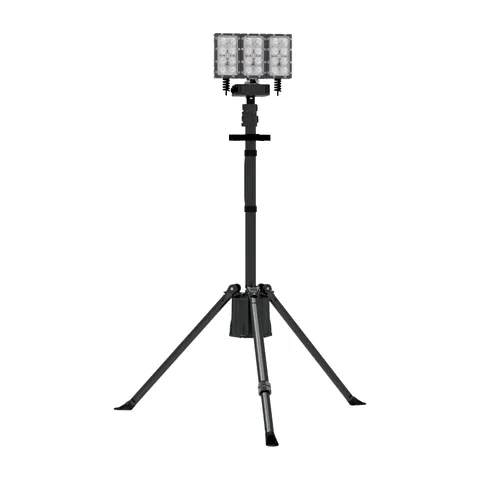
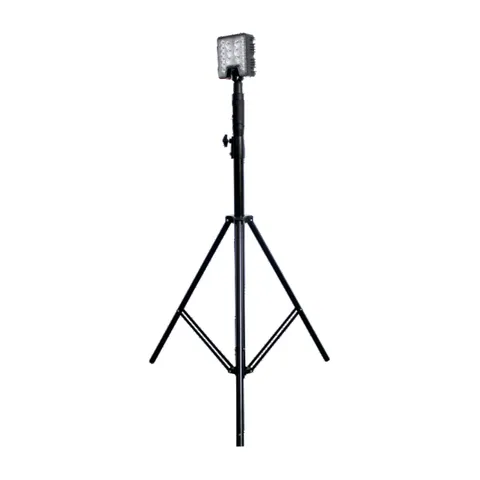
- 2–2.6 m: one-person tripod and case lights for a vehicle, a doorway or a small work area. Examples: HZ6125 (2.2 m), HZ6123 (2.6 m).
- 3–4.5 m: scene lighting for a road crash, a building front or a section of track. Examples: HZ6129 (3.8 m), HZ6133 (4.5 m).
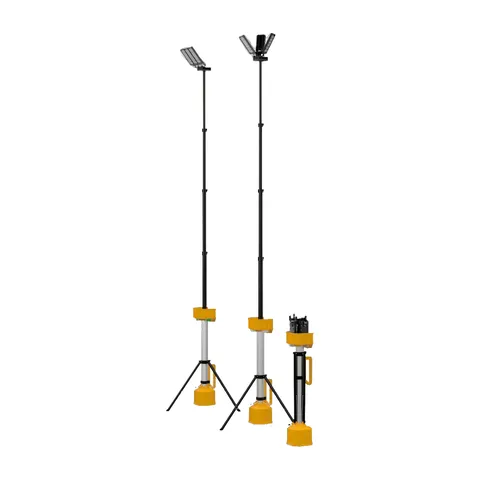
- 5–7 m and above: large incidents, flood zones, rail and construction sites. Examples: HZ6132 (3 or 5 m), GAD506 (4.5 or 6 m), HZ6180 (7.1 m).
Heads that aim independently let one mast light all around (360°) or flood one side only. That matters at roadside scenes, where light must not dazzle oncoming drivers.
Output: watts, lumens and lux at distance
Lumens describe the total light; lux at a stated distance describes what lands on the work. Compare towers by lux at 10 m or 20 m where the manufacturer gives it. In our range, for example:
| Model | Power | Mast | Published figure | Power source |
|---|---|---|---|---|
| HZ6125 | 100W LED | 2.2 m | 750 lx at 10 m (max initial) | Battery, 15 Ah, Ex |
| HZ6129 | 180W LED | 3.8 m | 600 lx at 10 m (max initial) | Battery, 25 Ah, Ex |
| HZ6119 | 120W LED | 1.86 m | 8 h with spot and flood | Battery, 34 Ah |
| HZ6133 | 600W LED | 4.5 m | ≥65,000 lm, ≥1300 lx at 10 m centre | Mains / generator, battery backup |
| HZ6132 | 2 × 150W LED | 3 or 5 m | 35,000 lm | 700W inverter generator |
| HZ6180 | 4 × 500W LED | 7.1 m | 480 lx at 20 m | 5 kW generator |
LED or metal halide?
Some towers still offer metal halide or halogen lamps. LED is now the default for emergency use:
- Instant on and instant restrike. Metal halide lamps take minutes to warm up and longer to restart when hot.
- Lower power for the same light, so longer battery runtime or less fuel.
- Shock resistance when masts are moved or vehicles drive over rough ground.
- Long life: the LED heads on our panoramic systems are rated for 100,000 hours.
Metal halide still appears on large towers such as the GAD506, where some customers prefer it for very large areas.
Runtime and battery planning
For battery lights, plan runtime per mode against the length of a typical incident. The HZ6129 runs about 7 hours with all heads on and 13 hours on spot or flood alone; the HZ6125 runs 5, 10 or 14 hours depending on brightness. Rotate units or carry a charged spare for longer scenes, and charge at the station or in the vehicle rather than at the scene.
Set-up and transport
- One-person set-up: tripod systems around 8–12 kg can be carried by hand or on the back.
- Vehicle stowage: folded lengths from about 1 m (HZ6125, HZ6129) to cased units such as the HZ6116 (495 mm).
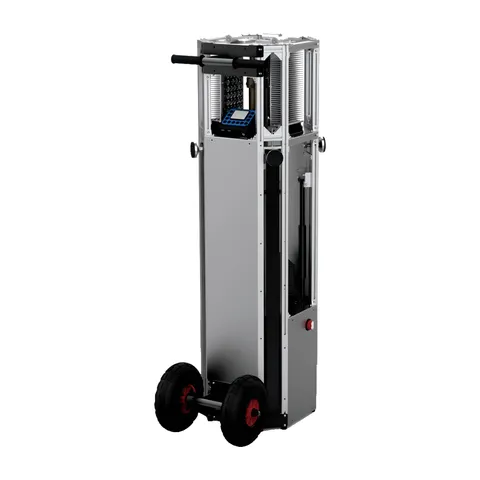
- Large towers: wheeled (HZ6133 with 10-inch wheels), trailer-mounted, or self-loading on hydraulic legs (HZ6180, 650 kg).
- Control: remote controls and Bluetooth apps let the operator dim or aim lights without climbing to the head.
Warning lights and public address
At roadside and public scenes the light tower also protects the scene. Look for built-in red-blue or amber warning lights (HZ6129, HZ6116) and, for crowd or evacuation situations, a PA speaker (the HZ6119 has 30W).
Lighting inside hazardous areas
At refinery fires, gas leaks, tanker incidents and plant turnarounds, the scene may be a classified area. Generator towers cannot go inside it. Use Ex-certified battery area lights inside the zone and generator towers outside it. The HZ6129 and HZ6125 are Ex eb ib mb IIC T6 Gb, suitable for Zone 1 and Zone 2. See Zone 0, 1 and 2 explained.
Three typical scene layouts
Road traffic collision at night
One 3–4 m tripod light behind the vehicles, aimed one-sided onto the casualty area so oncoming drivers are not dazzled, with its red-blue warning lights facing traffic. Headlamps for the cutting crew. A case light at the casualty handover point.
Building fire or collapse
Two or three tripod or wheeled towers at the corners of the building front, lighting the walls and access routes in 360° mode. A mains or generator tower for the command post and casualty clearing station if the incident runs for hours.
Plant or refinery incident
Ex-certified battery area lights (HZ6125 or HZ6129) inside the classified area around the leak or fire, generator towers lighting the approach roads and staging area outside it, and Ex headlamps and searchlights for every responder entering the zone.
Buying checklist
- Typical scene size and duration
- Required lux at the point of work and on approaches
- Power source: battery for first response, generator or mains for long duration
- Mast height and 360° or one-sided lighting
- Hazardous-area use: Ex marking required?
- Weight, stowed size and number of people to set up
- Warning lights, PA, remote or app control
- Charging and refuelling plan
Send your requirements through the quote form and we will suggest a mix of units.
Frequently asked questions
How bright should an emergency light tower be?
Enough to give the required lux at the point of work. As a reference, OSHA 1926.56 requires at least 5 foot-candles (about 54 lux) for general construction areas and 10 foot-candles (about 108 lux) at tunnel headings during drilling; casualty care and cutting often need more.
Battery or generator light tower?
Battery towers set up fastest and are silent, and Ex-certified models can be used in hazardous areas. Generator towers run longer and give more output but must stay outside classified areas.
How high should the mast be?
2–2.6 m for small work areas, 3–4.5 m for typical incident scenes, 5–7 m or more for large sites. Higher masts light larger areas more evenly with less glare.
Can a light tower be used in a Zone 1 area?
Only if it is Ex-certified for Zone 1, such as the HZ6129 and HZ6125 (Ex eb ib mb IIC T6 Gb). Generator towers are not certified for hazardous areas.
How long does a battery light tower run?
It depends on power and mode. The HZ6129 runs about 7 hours with all heads on and 13 hours on spot or flood alone; the HZ6119 runs at least 8 hours with spot and flood.
Further reading
- OSHA 29 CFR 1926.56: Illumination
- IECEx: International Electrotechnical Commission System for Certification to Standards Relating to Equipment for Use in Explosive Atmospheres
Need lights for a project? Send the zone, gas group and quantities and we will suggest models and a price.
Get a quote