A firefighter's flashlight is used in exactly the places where ordinary electrical equipment is most dangerous: leaking gas mains, fuel spills, tanker accidents, chemical plants and smoke-filled rooms. That is why many fire departments specify intrinsically safe firefighter flashlights, and why the right-angle light clipped to the turnout coat has become the standard personal light in many services.
This guide explains what makes a good firefighter flashlight, how intrinsic safety applies to fire work, how to choose between right-angle and straight lights, and how to build a station issue list.
Why intrinsic safety matters for firefighters
Firefighters routinely enter atmospheres that nobody has classified: a basement filling with natural gas, a car park after a fuel tank rupture, a warehouse where solvents are leaking. An ordinary flashlight can ignite such an atmosphere through a spark at the switch, at the battery contacts or if the light is dropped and broken.
An intrinsically safe light limits the electrical energy in its circuits so that no spark or hot surface can ignite the gas group it is certified for. Look for:
- Gas group IIC (or Class I, Groups A–D in North America), because responders cannot know in advance whether hydrogen or acetylene is present.
- Zone 1 protection level (Gb) or, in the US and Canada, a Class I, Division 1 listing. Our Class 1 Div 1 guide explains the North American ratings.
- A temperature class of T4 or better.
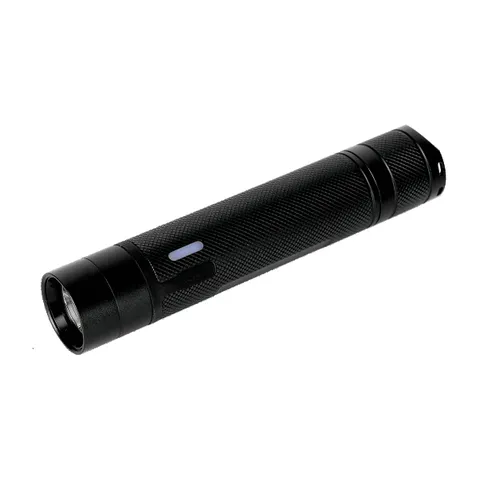
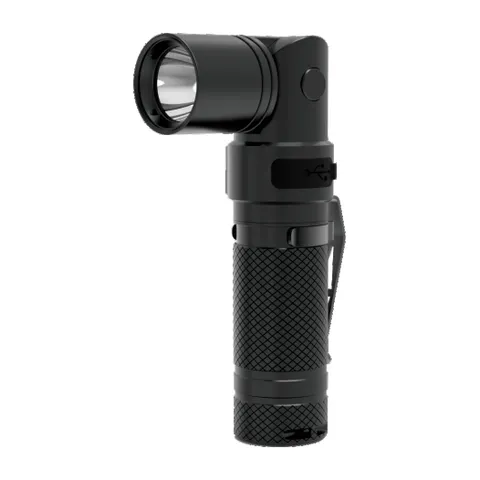
Our compact lights such as the HZ7302A and HZ7303 are marked Ex ib IIC T4 Gb. UL, ATEX and IECEx certified versions are available for departments that require them.
Right-angle or straight flashlight?
| Right-angle light | Straight flashlight | |
|---|---|---|
| Where it is carried | Clipped to the turnout coat or strap, pointing forward | In a pocket or holster, or in the hand |
| Hands | Both hands free for tools, hose and casualties | Occupies one hand unless mounted |
| Beam direction | Follows the body; head can be angled up or down | Wherever the hand points |
| Typical use | Interior attack, search, ladder work | Size-up, scene survey, inspection, spotting at distance |
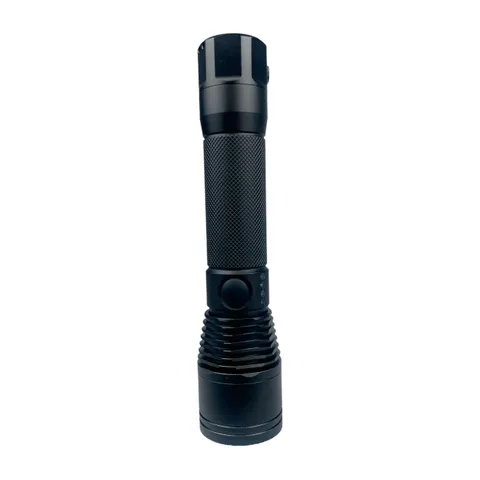
| Example | HZ7303, head turns 0–180°, magnetic tail | HZ7302A with red signal, HZ7623 |
Many departments issue both: a right-angle light on every coat and a straight or hand-held searchlight on each apparatus.
Beam and brightness in smoke
More lumens do not always mean better vision in smoke. A very bright, wide beam lights up the smoke particles in front of the firefighter and reflects back as glare, the same way high-beam headlights do in fog. What helps:
- A focused beam that cuts through smoke rather than flooding it. Zoom lights such as the HZ202C let the user choose.
- Mounting low: a light at chest or waist height reflects less back into the eyes than one at helmet height.
- A red or signal mode for marking position and for being seen by crew members. The HZ7302A has a red signal function in the tail switch.
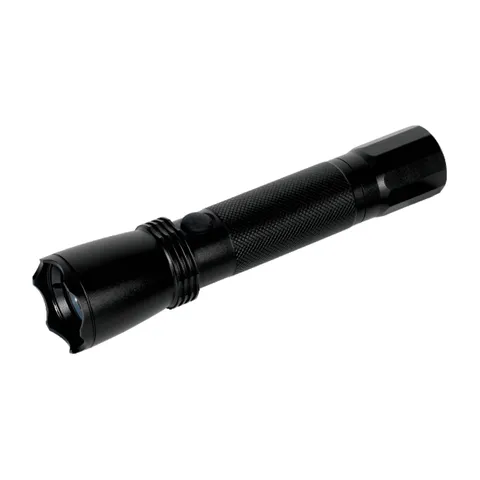
- A hand-held searchlight for long throw outdoors and for searching large spaces: the HZ7106A combines a spot beam with side flood panels.
Built for fire-ground abuse
- Water: lights are hosed, dropped in puddles and washed down after every call. IP66 is the minimum; IP68 with a stated depth is better. The HZ7302A is rated to 5 m for 2 hours.
- Heat: no portable flashlight is designed for direct flame. Check the stated operating temperature range and keep lights clipped where turnout gear shields them.
- Gloves: large switches that work with structural firefighting gloves, and a mode sequence simple enough to use blind.
- Drops: a light that survives falling from a ladder. The BAD206 is rated for a 9 m drop.
- Mounting: a strong clip or holder that does not snag on the way through a window, and a magnet for hands-free use on vehicles and steel structures.
Runtime and charging at the station
Most incidents are short, but a working fire, a hazmat incident or a search can run for hours, and lights are often left switched on during overhaul. Choose lights with at least 8 hours on the working mode and a battery indicator, and make charging part of the apparatus check:
- Charge in the station or on the apparatus, never in a hazardous atmosphere.
- Use vehicle-mounted chargers or a central charging case such as the HZ1110, which runs from 12–36 V vehicle power.
- Use only the battery type named on the certificate; a non-approved battery removes the intrinsic safety rating.
Station issue list
| Item | Issue | Model example |
|---|---|---|
| Right-angle intrinsically safe light | One per firefighter | HZ7303 |
| Compact flashlight with red signal | One per firefighter or per officer | HZ7302A |
| Explosion-proof headlamp | For technical rescue and confined space teams | HZ5130 |
| Hand-held explosion-proof searchlight | Two per apparatus | HZ7106A |
| Portable scene lighting | One per apparatus or per rescue unit | HZ6125 tripod system |
| Position and warning lights | For marking hazards and casualties | HZ4800, HZ4801 |
Buying for a department or as a distributor
Fire departments usually buy through tenders and approved dealers. If you supply fire services, ask for: the certificate for each model and the scheme your country accepts, sample units for user trials, spare batteries and chargers, and branding or numbering for asset tracking. We supply fire-service lights under the manufacturer's brand or as private label; see OEM and private label.
Send the quantities and the certification your department or tender requires through the quote form.
Frequently asked questions
Do firefighters need intrinsically safe flashlights?
Many departments require them because firefighters enter unclassified atmospheres such as gas leaks and fuel spills. An intrinsically safe light certified for gas group IIC (or Class I, Groups A–D) cannot ignite those atmospheres through sparks or hot surfaces.
Why do firefighters use right-angle flashlights?
A right-angle light clips to the turnout coat and points forward, leaving both hands free for tools, hose and casualties, while the beam follows the body.
Is a brighter flashlight better in smoke?
Not necessarily. A very bright wide beam reflects off smoke and causes glare. A focused beam mounted at chest or waist height usually gives better vision.
What IP rating should a firefighter flashlight have?
At least IP66 for hosing and rain; IP68 with a stated depth if lights may be submerged. The HZ7302A is rated IP68 to 5 m for 2 hours.
Do you supply UL-certified firefighter flashlights?
UL, ATEX and IECEx certified versions are available. Tell us the certification your department requires and we confirm the listed models.
Further reading
- NFPA 70: National Electrical Code
- UL Product iQ: certification directory
- IECEx: International Electrotechnical Commission System for Certification to Standards Relating to Equipment for Use in Explosive Atmospheres
- IEC: Ingress Protection (IP) ratings, IEC 60529
Industries: Fire & Emergency Rescue
Product lines: Explosion-Proof Flashlights · Portable Searchlights
Need lights for a project? Send the zone, gas group and quantities and we will suggest models and a price.
Get a quote