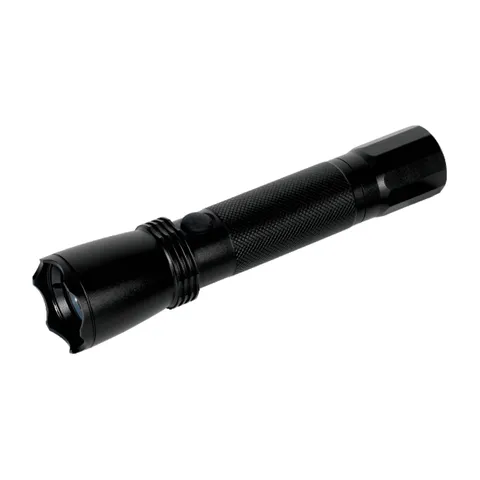
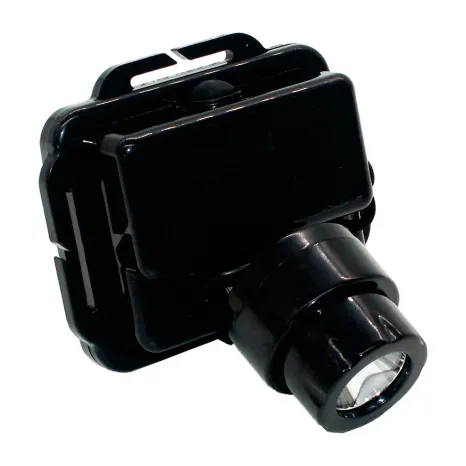
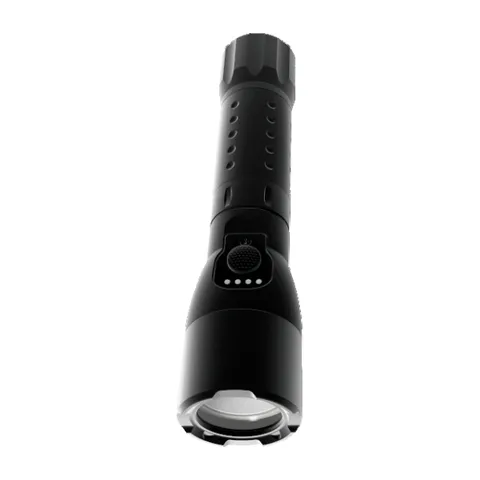
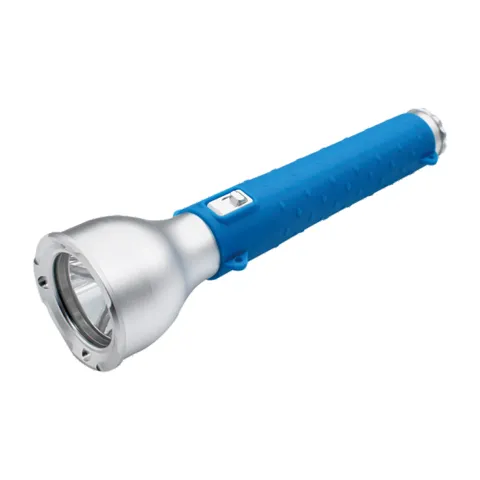
From the outside, an explosion-proof flashlight and a good industrial flashlight look much the same: an aluminium or plastic body, an LED, a rechargeable battery and a switch. The difference is inside, in how the light is designed, tested and certified, and it decides whether the light can be carried into a place where gas, vapour or dust can explode.
This article explains how an ordinary flashlight can ignite a flammable atmosphere, what an explosion-proof flashlight does differently, how to tell a genuine one from a marketing claim, and when a regular light is perfectly acceptable.
The short answer
A regular flashlight is designed to give light. An explosion-proof flashlight is designed so that nothing inside it can ignite the surrounding atmosphere, even when it is switched, dropped, damaged or has a fault, and it has been tested and certified to prove it. Only a certified light with an Ex marking may be used in a hazardous area.
How a normal flashlight can ignite gas
- Switch sparks. Every time a mechanical switch opens or closes a circuit, a tiny arc forms. In air it is harmless; in a hydrogen or acetylene atmosphere, the energy needed for ignition is very small.
- Battery faults. A lithium-ion cell can deliver a large current into a short circuit, producing sparks and heat. A dropped light with a damaged cell or loose spring contact is a real ignition source.
- Hot surfaces. LEDs are efficient, but their drivers and the LED board can still run hot, especially in high modes. If a surface exceeds the ignition temperature of the gas, ignition can occur without any spark.
- Static electricity. Large plastic surfaces can build up static charge when rubbed, and discharge as a spark.
- Mechanical sparks. Light metals striking rusty steel can produce incendive sparks, which is why certification standards restrict light-metal content in some enclosures.
What an explosion-proof flashlight does differently
Certified flashlights use one or both of two main approaches:
- Intrinsic safety (Ex ia, Ex ib): the circuit is designed so that the energy available in a spark or on a hot surface is too low to ignite the gas group, even with one fault (ib) or two faults (ia). This suits small lights and headlamps, such as the HZ7623 and HZ5130 (Ex ib IIC T4 Gb).
- Flameproof enclosure (Ex d, Ex db): parts that could ignite gas are enclosed in a housing strong enough to contain an internal explosion and designed so that flames cannot escape through its joints. This suits higher-power lights such as the HZ7625 (Ex d ib IIC T6 Gb) and the HZ7211 diving light.
Our article on intrinsic safety vs flameproof compares the two in detail. Either way, the design is then tested by a certification body: spark-ignition tests in explosive gas mixtures, temperature measurement of every surface, impact and drop tests, battery and seal tests, and an audit of the factory's quality system.
Side-by-side comparison
| Regular flashlight | Explosion-proof flashlight | |
|---|---|---|
| Design goal | Brightness, size, price | No ignition under normal use and faults |
| Circuit energy | Unlimited | Limited (intrinsic safety) or enclosed (flameproof) |
| Surface temperature | Not controlled | Capped by temperature class, e.g. T4 = 135 °C |
| Testing | Manufacturer's own, if any | Independent certification body plus factory audit |
| Marking | None or marketing terms | Ex marking such as Ex ib IIC T4 Gb plus certificate number |
| Brightness | Often very high | Moderate; energy is limited on purpose |
| Battery | Any compatible cell | Only the cell named on the certificate |
| Legal in hazardous areas | No | Yes, within the zones and gas groups on the marking |
"Spark-proof", "non-sparking", "industrial": words that prove nothing
Consumer and industrial flashlights are often sold with words such as "spark-proof", "safe", "industrial grade" or even "explosion-proof design" in the listing. Without a certificate, none of these words means the light may be used in a hazardous area. What counts:
- An Ex marking on the light itself, for example Ex ib IIC T4 Gb, and for ATEX the ⬡Ex symbol and category such as II 2 G. See how to read an Ex marking.
- A certificate number that you can check: IECEx certificates are in the public database on iecex.com; UL listings in UL Product iQ.
- The marking and certificate cover the exact model you are buying.
Terms such as "intrinsically safe flashlight", "ATEX torch" and "Class 1 Div 1 light" are explained in our guide to flashlight terms.
What the rules say
- United States: OSHA 29 CFR 1910.307 requires electrical equipment in hazardous locations to be approved for the class, division or zone; see our Class 1 Div 1 guide.
- European Union: Directive 1999/92/EC requires employers to classify hazardous areas and use equipment of the matching ATEX category.
- Elsewhere: most countries apply IEC 60079-based rules through national law or the site operator's standards.
In practice, the site owner decides what may enter its zones, and most oil, gas and chemical sites stop personal flashlights at the gate. The same logic applies to phones, cameras and radios carried into a zone.
When a regular flashlight is fine
Outside classified areas, a good industrial flashlight is often the better choice: brighter, cheaper and not limited by certification. Workshops, warehouses, vehicles, security patrols and general maintenance outside the zones do not need explosion protection. Our general industrial models, such as the HZ7500 10W flashlight, are clearly marked as non-Ex and are intended for those uses. Many buyers order a mix: certified lights for people who enter the zones, general lights for everyone else.
Is the price difference worth it?
Certified flashlights cost more because of design limits, certification testing, factory audits and controlled components. The difference is small compared with the consequences of an ignition, and with quantity pricing it is a modest share of a site's safety budget. For what drives the price and how to compare quotes, see buying explosion-proof lights from China and the flashlight buying guide.
Browse our explosion-proof flashlights or send your requirements through the quote form.
Frequently asked questions
Can I use a regular flashlight in a hazardous area?
No. Inside classified zones only certified lights with an Ex marking covering the zone, gas group and temperature class may be used. A regular flashlight can ignite gas through switch sparks, battery faults or hot surfaces.
What is the difference between explosion-proof and intrinsically safe?
Intrinsically safe lights limit circuit energy so sparks cannot ignite gas; flameproof (explosion-proof) lights contain any ignition inside a strong enclosure. Both are certified types of explosion protection.
Are 'spark-proof' flashlights safe for gas areas?
Not unless they carry an Ex marking and a certificate you can verify. Marketing words such as spark-proof or industrial grade prove nothing.
Why are explosion-proof flashlights less bright?
Intrinsic safety deliberately limits the energy in the circuit, so most certified pocket lights use 3–5 W LEDs. They are designed to be bright enough for work, not as bright as possible.
Is an LED flashlight safe because it has no hot bulb?
No. LED drivers, switches and lithium batteries can still produce sparks and hot surfaces. Only certification proves a light is safe for a hazardous area.
Further reading
- OSHA 29 CFR 1910.307: Hazardous (classified) locations
- EU-OSHA: Directive 1999/92/EC on workers in potentially explosive atmospheres
- IECEx: International Electrotechnical Commission System for Certification to Standards Relating to Equipment for Use in Explosive Atmospheres
- UL Product iQ: certification directory
Industries: Oil, Gas & Petrochemical · Mining & Tunnelling · Fire & Emergency Rescue
Product lines: Explosion-Proof Flashlights
Need lights for a project? Send the zone, gas group and quantities and we will suggest models and a price.
Get a quote