Offshore and marine work combines two things that destroy ordinary lights: flammable gas and seawater. A platform's process modules, a tanker's cargo deck and an FPSO's turret are classified hazardous areas, and every light carried through them needs an Ex marking. The same lights get drenched by spray, hosed down with deck wash, dropped on steel grating and occasionally dropped over the side. They also have to work when they matter most: at night, in bad weather, during an emergency.
This guide covers what is different about lighting at sea, how to read the requirements, and what to put in a crew's kit.
Hazardous areas at sea
Offshore installations and ships classify their hazardous areas in the same Zone 0, 1 and 2 system used onshore, but under their own standards and rules:
| Asset | Typical hazardous areas | Standards and rules |
|---|---|---|
| Fixed and mobile offshore units (platforms, jack-ups, semi-submersibles, FPSOs) | Around wellheads, drill floor, mud handling, process and separation modules, gas compression, turret and swivel | IEC 61892-7 (offshore units, hazardous areas) with the IEC 60079 series; classification society rules |
| Oil, chemical and gas tankers | Cargo tanks (Zone 0), cargo deck and areas around vents and manifolds (Zone 1 and 2), cargo pump rooms | IEC 60092-502 (tankers, special features); flag state and classification society rules |
| Supply and support vessels | Usually limited: areas near fuel or chemical tank vents, and anywhere alongside a platform's hazardous zone | Vessel's own classification, plus the platform's rules when working alongside |
The practical rule is the same as onshore: a portable light must be rated for the worst zone it will enter. On a platform or a tanker deck, that normally means Zone 1 (EPL Gb), gas group IIA or IIB at minimum, and IIC where hydrogen or acetylene can be present. Many operators simply specify IIC and T4 or better for all portable lights so that no one has to check the zone drawing before picking up a torch. See Zone 0, 1 and 2 explained and how to read an Ex marking.
Certification: IECEx is the common language offshore
Offshore operators work across borders, and their equipment lists usually ask for IECEx certification, ATEX for units in EU waters, or both. Classification societies and flag states may add their own requirements. Before buying lights for an offshore contract, check the operator's equipment specification for:
- The certification schemes accepted (IECEx, ATEX, national).
- Minimum gas group and temperature class.
- Minimum ingress protection and any corrosion requirements.
- Battery chemistry and charging rules on board.
Our Ex-marked lights are certified in China. If your project needs IECEx or ATEX, tell us at the inquiry stage so we can confirm what is available for the models you need; our certification guide explains the differences.
Water: spray, deck wash and the sea
Sea conditions test both kinds of water protection: powerful jets from green water and deck washing, and immersion when a light is dropped into a bilge, a flooded compartment or the sea. The rating to look for is a dual rating, IP66 / IP68, with the immersion depth and time stated.
| Model | Marking | Water rating | Use at sea |
|---|---|---|---|
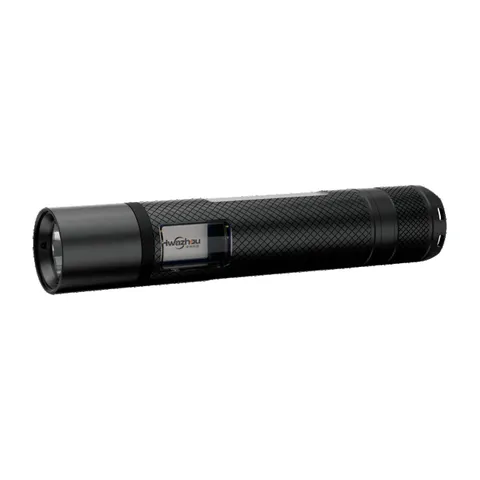
| HZ7307 | Ex ib IIC T4 Gb | IP66 / IP68 (5 m, 2 h) | Pocket flashlight for deck crew and permit holders |
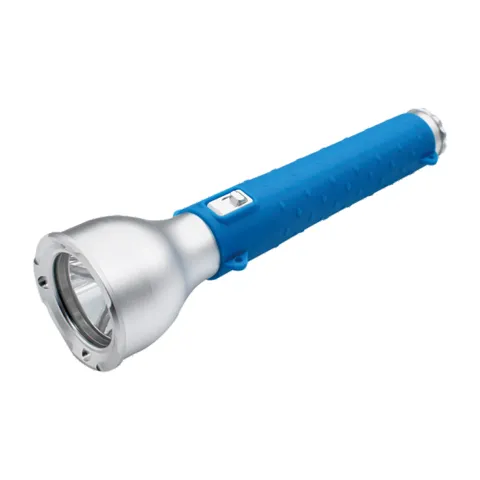
| HZ7211 | Ex d IIC T6 Gb | IP68 (50 m, 1 h) | 10W flameproof light for diving support and flooded spaces |
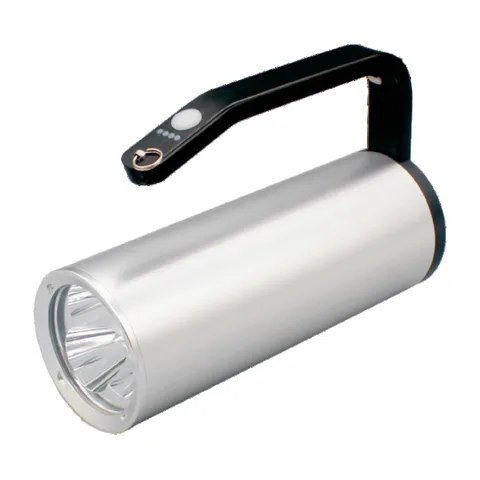
| HZ7101 | Ex db ia IIC T6 Gb | IP68 (2 m, 1 h) | Hand searchlight with power-bank output for radios |
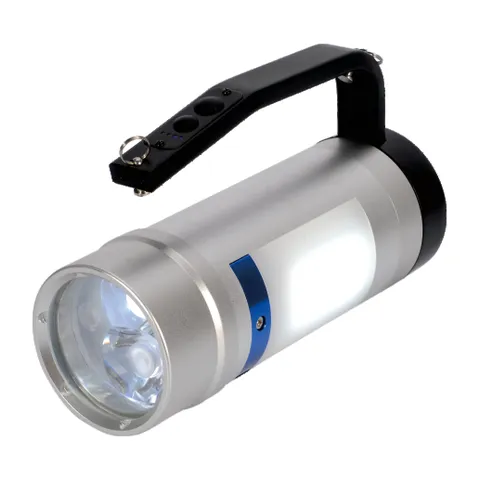
| HZ7106B | Ex db ia IIC T6 Gb | IP66 / IP68 (2 m, 1 h) | Twin-beam searchlight for water search and night deck work |
| HZ4800 | Ex ib IIC T4 Gb | IP68 | Position marker for barriers and work areas on deck |
IP tests use fresh water, so they say nothing about salt. For offshore use also ask about the housing and lens materials, the coating, and whether external screws and clips are stainless. Rinse lights with fresh water after exposure, and check seals more often than you would onshore. Our IP rating guide covers this in detail.
Searching water at night
When someone goes overboard, or a small boat must be found alongside, a long-throw searchlight on the bridge wing or the deck rail is often the first tool used. What matters is throw, the ability to hold the beam steady, and a light that keeps working after being soaked.
- Choose on peak candela and beam distance rather than watts: a twin-beam light such as the HZ7106B reaches furthest in our range.
- Keep at least one charged searchlight at each muster or watch station, with a charging point in the accommodation or bridge, outside the hazardous area.
- Use the flood panels to light the rescue zone at the rail once the person has been located.
Personal lifejacket lights are separate equipment, approved under the maritime life-saving appliance rules, and are not covered here. See our searchlight guide for more on throw and beam.
Holds, tanks and enclosed spaces
Cargo holds, ballast tanks, void spaces and cargo tanks are confined spaces with their own entry rules. The lighting principles from onshore tank entry apply, with a few marine points:
- Steel hull spaces are conductive and often wet. Use battery lights or extra-low-voltage corded lamps with the transformer outside the space.
- Cargo tanks on tankers are Zone 0 until gas-freed, and most company rules require explosion-protected lighting inside throughout the job.
- Free-standing battery lights such as the HZ5282 (Ex db eb ib mb IIC T6 Gb, up to 80 hours on low) keep access hatches clear of cables. In non-hazardous dry cargo holds, the HZ6330 loading lantern gives 360° light for cargo work.
- Every entrant carries an independent light, normally an Ex headlamp, so they can find the way out if the area light fails.
The full method is in our confined-space lighting guide.
Batteries and logistics at sea
- Charging on board. Set up charging stations in the accommodation, workshop or another safe area. Most Ex certificates forbid charging inside the hazardous area.
- Getting lights offshore. Lights with lithium-ion batteries travel by supply vessel or helicopter as dangerous goods (lithium batteries contained in equipment). Helicopter transport follows air dangerous-goods rules, so plan documents with the logistics base.
- Spares. Resupply can take days. Hold spare lights rather than spare cells; changing cells on certified lights is restricted, as our maintenance guide explains.
Sample lighting kit for a 20-person platform maintenance crew
| Item | Qty | Purpose |
|---|---|---|
| Ex headlamp, IP66 or IP66 / IP68 | 24 | One per person plus 20% spares |
| HZ7307 pocket flashlight (IP66 / IP68, 5 m) | 10 | Supervisors, permit holders, fire watch |
| HZ7106B twin-beam searchlight | 2 | Night search, overboard response, high-level inspection |
| HZ5282 portable Ex light | 4 | Area and escape lighting inside tanks and modules |
| HZ4800 Ex position lights | 10 | Marking barriers and work-area limits on deck |
| Charging station | 1 | In the accommodation or workshop, outside the hazardous area |
Offshore lighting checklist
- Operator's equipment specification read: schemes, gas group, temperature class, IP.
- All portable lights marked for Zone 1, with gas group and temperature class covering every area they will enter.
- Dual IP66 / IP68 rating with stated depth for lights used on deck or near water.
- Housing, lens and fasteners suitable for salt air.
- Searchlights at watch and muster stations, charged and checked.
- Independent personal light for every confined-space entrant.
- Charging only in safe areas; dangerous-goods documents for transport offshore.
- Freshwater rinse and seal checks in the maintenance routine.
Send us the asset type, the operator's specification and crew numbers through the inquiry form, and we will propose a kit and confirm certification. Kits can carry your company's branding through our OEM service.
Frequently asked questions
What Ex rating do portable lights need on an offshore platform?
At least the worst zone they will enter, which on a platform or tanker deck is normally Zone 1 (EPL Gb). Many operators specify gas group IIC and T4 or better for all portable lights so they can be used anywhere on the installation.
Is IECEx required offshore?
It depends on the operator and location. Many offshore equipment specifications ask for IECEx, units in EU waters need ATEX, and classification societies may add requirements. Check the operator's specification before ordering.
What IP rating is best for marine use?
A dual rating such as IP66 / IP68 with a stated depth, so the light resists both deck-wash jets and immersion. Check corrosion resistance separately, because IP tests use fresh water.
Can explosion-proof lights be charged on board?
Yes, in a safe area such as the accommodation or workshop. Most Ex certificates forbid charging inside the hazardous area.
Which light is best for man-overboard search?
A long-throw searchlight with a high candela figure and an IP66 / IP68 rating, such as the HZ7106B twin-beam model, kept charged at watch and muster stations.
Further reading
- IEC 61892-7: Mobile and fixed offshore units, electrical installations, hazardous areas
- IECEx: International Electrotechnical Commission System for Certification to Standards Relating to Equipment for Use in Explosive Atmospheres
- IEC: Ingress Protection (IP) ratings, IEC 60529
- IATA: Lithium batteries
Industries: Oil, Gas & Petrochemical · Ports, Marine & Offshore
Product lines: Portable Searchlights
Need lights for a project? Send the zone, gas group and quantities and we will suggest models and a price.
Get a quote