Flashlights and headlamps light the person. Explosion-proof work lights light the job: the flange being unbolted, the pump being lifted, the inside of a vessel being inspected. They are bought in smaller numbers than personal lights, but they decide whether a repair crew can work safely at night or inside a plant that has not been gas-freed.
This guide covers the main types of portable explosion-proof work light, how to choose between battery and cabled units, how much light different jobs need, what the Ex marking should say, and a sample kit for a maintenance team.
Four types of portable work light
| Type | What it does | Typical use | Example |
|---|---|---|---|
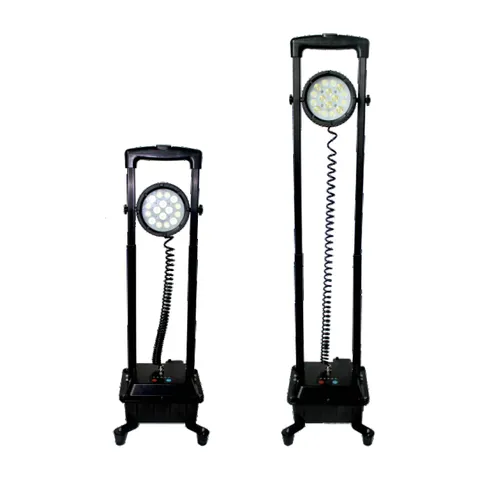
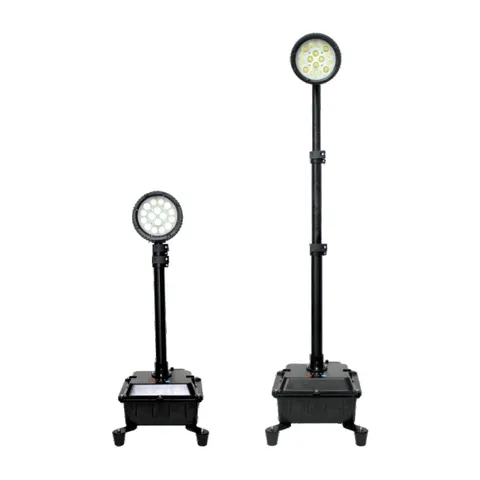
| Battery mast light | Telescopic stand lifts the head to 1.4–1.5 m and floods a work area | Pump and valve maintenance, night repairs, plant turnarounds | HZ6103, HZ6105, 50W, Ex db eb ib mb IIC T6 Gb |
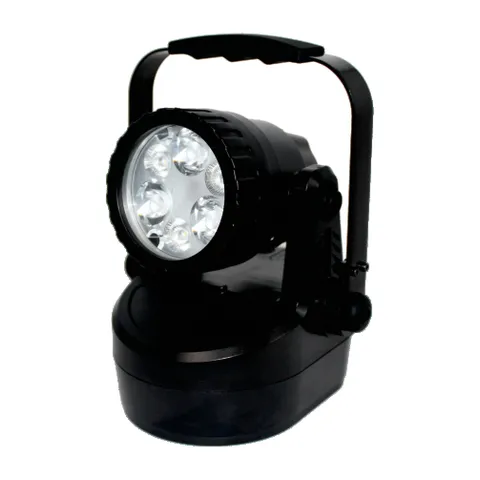
| Portable area light | Compact box light that stands on the ground or hangs; long runtime on low | Scaffold platforms, pipe racks, standby lighting | HZ5282, 12W, up to 80 h on low |
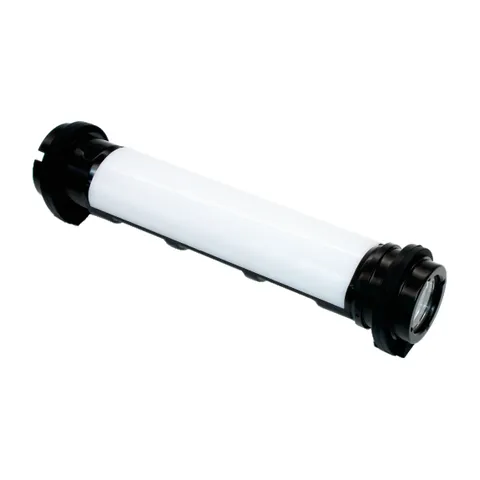
| Inspection tube or torch-and-tube light | Torch at one end, diffused tube light along the body | Looking inside equipment, under machinery, in cable trays | HZ6601, HZ6610 |
| Cabled hand lamp | Low-voltage or mains-fed lamp on a cable, no battery to run down | Tank and vessel entry, long jobs in one place | HZ6320, 12W, 12–36 V or 220 V |
Most sites need more than one type. A turnaround crew typically uses mast lights for the work face, a tube or torch-and-tube light for close inspection and headlamps for movement. For larger areas, a tripod system such as the HZ6129 covers what a single work light cannot; see our light tower guide.
Battery or cabled?
| Battery work light | Cabled hand lamp | |
|---|---|---|
| Set-up | Carry in and switch on | Needs a supply point, cable route and, for low voltage, a transformer outside the zone |
| Runtime | Limited by battery (typically 10–18 h on work mode for 50W mast lights) | Unlimited while powered |
| Trip and damage risk | None from cables | Cables across walkways and through manways |
| Charging | Must be charged outside the hazardous area | No charging |
| Best for | Moving work, outdoor plant, emergency repairs | Long, static jobs inside tanks and vessels |
Inside metal vessels, many site rules require extra-low voltage for hand lamps (commonly 12 V or 24 V supplied from a safety transformer outside the vessel), because a damaged cable or lamp in a conductive, confined space is a shock risk as well as an ignition risk. Check your permit-to-work rules; our confined space lighting guide covers this in detail.
How much light does the job need?
Work lights are judged by the light that reaches the job, not by watts. As a minimum reference, OSHA 29 CFR 1926.56 sets illumination levels for construction work in foot-candles (1 fc ≈ 10.8 lux):
| Area or task (OSHA 1926.56) | Minimum |
|---|---|
| General construction area lighting | 5 fc (about 54 lux) |
| Concrete placement, excavation and waste areas, access ways | 3 fc (about 32 lux) |
| Tunnels, shafts and general underground work areas | 5 fc; 10 fc during drilling, mucking and scaling |
| General construction plant and shops | 10 fc (about 108 lux) |
| First-aid stations, infirmaries and offices | 30 fc (about 323 lux) |
These are minimums for moving around and general work. Mechanical work on bolts, seals and instruments needs considerably more light on the task, which is why a work light aimed at the job beats raising the general level. Two practical rules:
- Light the task from two sides where you can. One light behind the worker puts the job in their own shadow.
- Raise the head. A head at 1.4–1.5 m on a mast throws light over obstructions and reduces glare compared with a light on the ground.
What the Ex marking should say
Work lights combine several protection types because they contain a large battery, a high-power LED driver and switches. A marking such as Ex db eb ib mb IIC T6 Gb on the HZ6103 means:
- db: flameproof enclosure for the parts that could ignite gas;
- eb: increased safety for terminals and connections;
- ib: intrinsically safe control circuits;
- mb: encapsulated electronics;
- IIC T6 Gb: all gas groups, maximum surface temperature 85 °C, suitable for Zone 1 and Zone 2.
Check three things against the area classification: the protection level (Gb for Zone 1), the gas group (IIC covers hydrogen and acetylene) and the temperature class. Note that some lamps are built for Zone 2 only: restricted-breathing protection (nR), as on the HZ6320 cabled lamp, is normally a Zone 2 concept, so confirm the approved zone on the certificate before using it in Zone 1. For more detail see how to read an Ex marking.
Several useful work lights in our range, such as the HZ6609 multi-function light and the HZ5510 hand-crank light, are general industrial models without Ex certification. They are good value for workshops, roadside repairs and emergency kits, but must stay out of classified areas.
Features that matter on site
- Runtime on the working setting long enough for a shift with all heads on, not only on the lowest mode. The HZ6103 runs 10 h with both heads on work mode and 18 h with one head.
- Separate spot and flood heads so one unit can light a work face and reach a valve at height.
- IP66 or better for outdoor plant and wash-down; IP54 lights are for dry inspection only. See IP ratings explained.
- Weight and carrying. Mast lights around 7 kg can be carried up a stair tower by one person; heavier units need two.
- Battery indicator so crews swap units before a light dies mid-job.
- Charging plan. Large work lights take 6–8 hours to charge. Plan a charging area outside the zone and enough units to rotate.
A sample kit for a 6-person maintenance crew
| Item | Qty | Model example |
|---|---|---|
| Explosion-proof mast work light, 50W | 2 | HZ6103 |
| Portable area light with long low mode | 2 | HZ5282 |
| Torch-and-tube inspection light | 2 | HZ6601 |
| Explosion-proof headlamp | 6 | HZ5130 |
| General-issue explosion-proof flashlight | 6 | HZ7623 |
| Charging case for personal lights | 1 | HZ1110 |
For a full turnaround, scale this kit by the number of work fronts; our turnaround lighting plan shows how.
Buying checklist
- Zone, gas group and temperature class of the areas where the light will be used.
- Battery or cabled; for cabled lamps, the supply voltage and cable length.
- Runtime required with all heads on.
- Mast height and weight limit.
- IP rating.
- Certificate scheme your site accepts: national, IECEx, ATEX or UL.
- Quantity, spare batteries and charging arrangement.
Send the list through our quote form and we will propose models, quantities and a price. UL, ATEX and IECEx certified versions are available.
Frequently asked questions
What is an explosion-proof work light?
A portable light certified for use in explosive gas atmospheres, usually combining flameproof, increased-safety, intrinsically safe and encapsulated protection, such as Ex db eb ib mb IIC T6 Gb. It lights a work area rather than the person.
Battery or cabled work light for tank entry?
For long static jobs inside vessels, an extra-low-voltage cabled lamp fed from a transformer outside the vessel is common and avoids running out of battery. Battery lights are better for moving work and outdoor plant.
How long does a battery explosion-proof work light run?
It depends on the mode. A 50W mast light such as the HZ6103 runs about 10 hours with both heads on work mode and about 18 hours with one head.
Can I use an IP54 work light outdoors?
Only in sheltered, dry conditions. For rain, wash-down and outdoor plant choose IP66 or better.
Are all work lights in your range explosion-proof?
No. The HZ6103, HZ6105, HZ5282, HZ6601 and HZ6610 carry Ex markings; the HZ6320 is restricted-breathing (normally Zone 2). The HZ6609, HZ5510, HZ5511 and HZ6330 are general industrial models for use outside hazardous areas.
Further reading
- OSHA 29 CFR 1926.56: Illumination
- OSHA 29 CFR 1910.146: Permit-required confined spaces
- IECEx: International Electrotechnical Commission System for Certification to Standards Relating to Equipment for Use in Explosive Atmospheres
- IEC: Ingress Protection (IP) ratings, IEC 60529
Industries: Oil, Gas & Petrochemical · Mining & Tunnelling
Product lines: Work & Inspection Lights
Need lights for a project? Send the zone, gas group and quantities and we will suggest models and a price.
Get a quote